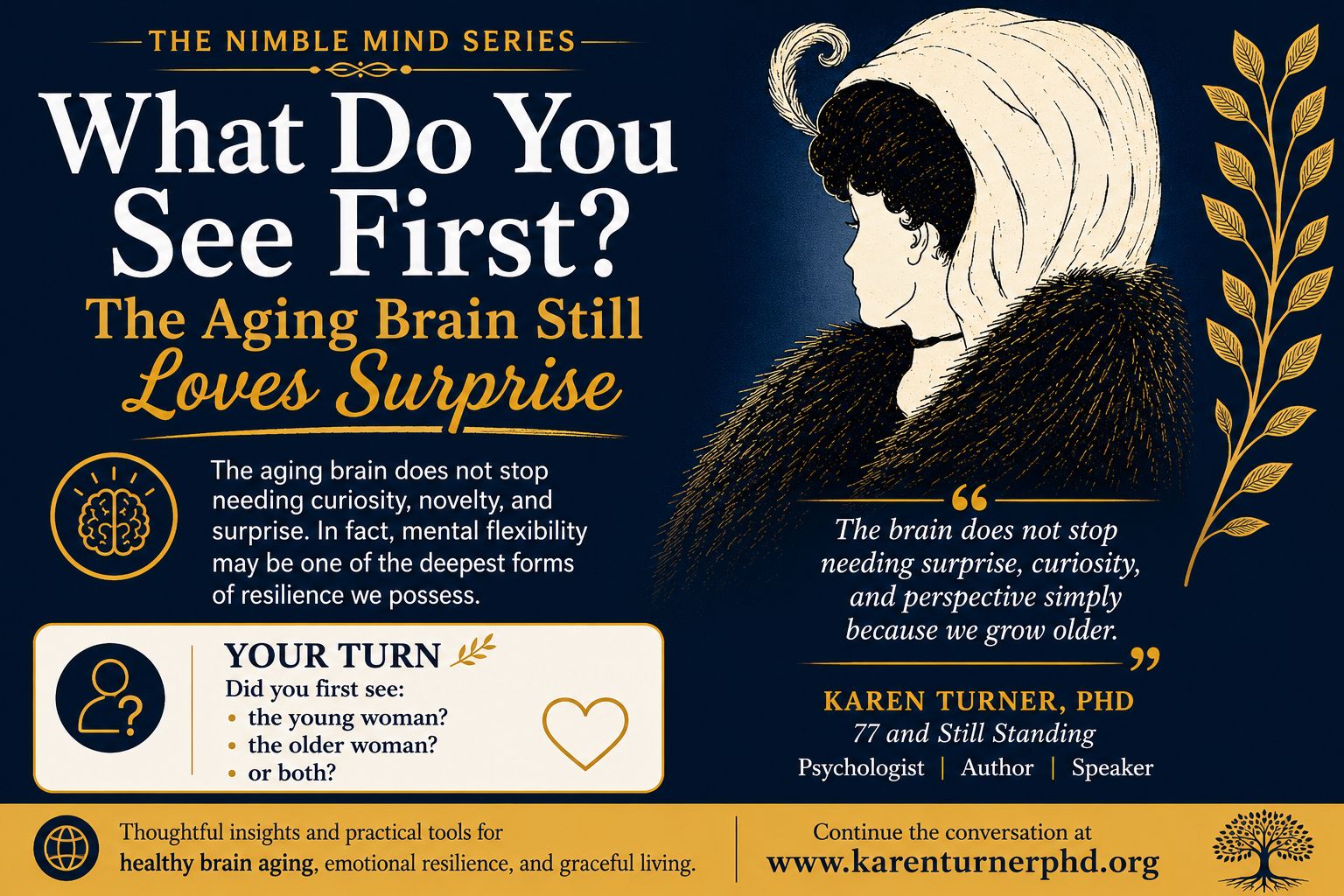
Two people can look at the very same image and see entirely different things, and that gap reveals something real about how the aging brain stays sharp. One person spots a young woman first. Another sees an older woman. Some see both immediately, while others need a long moment before the second image suddenly appears. That flicker of surprise, the instant when perception shifts, is not just a party trick. It may be one of the simplest, most enjoyable ways to keep an aging brain flexible.
Why Does the Brain Love Being Surprised?
The brain stays sharp not through certainty or repetition, but through novelty. Optical illusions work because they interrupt automatic thinking, forcing the mind to search, reconsider, and reinterpret what it is seeing. That small jolt of surprise is exactly the kind of stimulation that keeps neural pathways active well into later life.
Researchers studying healthy brain aging and cognitive wellness consistently find that continued mental engagement supports emotional resilience, cognitive flexibility, and overall psychological health. The brain thrives on stimulation, especially when that stimulation feels enjoyable rather than pressured, which is part of why something as simple as an image with two hidden faces can feel strangely energizing.
What Happens When Life Stops Surprising Us?
One of the quiet dangers of aging is not physical decline. It is mental narrowing: the slow tendency to stop exploring, stop questioning, and stop letting new perspectives in. Many people begin living inside increasingly familiar routines, the same schedules, the same conversations, the same assumptions. Routines offer comfort, but the brain still needs stimulation, challenge, and the occasional surprise to stay engaged.
How Curiosity Protects Emotional Health, Not Just Memory
Curiosity is not only intellectual. It is emotional. It keeps people open, allowing them to keep growing instead of becoming psychologically rigid. It helps us adapt to change, reconsider old assumptions, and stay emotionally connected to the people and world around us. That matters more in later life, not less. Many people quietly absorb the cultural message that aging means becoming smaller, more cautious, and less adventurous. But healthy aging is not about shrinking into predictability. It is about staying psychologically alive.
Simple Ways to Invite More Novelty Into Your Days
Meaningful growth in later life is often far quieter than dramatic reinvention. Sometimes it simply means staying willing to:
- Learn something new, even something small
- Reconsider an old belief
- Try unfamiliar technology
- Take a different route home
- Listen to new music
- Read outside your usual interests
- Let yourself see a familiar situation from another angle
The same mental flexibility that lets you suddenly see the hidden image in an optical illusion is often the same flexibility that helps people navigate grief, retirement, changing identities, and shifting family roles. Perspective matters. The ability to reinterpret experience matters. The willingness to stay emotionally and cognitively open matters.
The Takeaway
Healthy aging is not about pretending loss does not exist. It is about continuing to engage with life despite it, and novelty is one of the most enjoyable tools for doing that. Novelty stimulates the brain, interrupts autopilot, and gently encourages the mind to stay adaptive rather than fixed. It does not have to be dramatic. Sometimes it is simply allowing yourself to stay interested in life. So look again at the image. Did you see the young woman first, the older woman, or both? There is no wrong answer. Either way, your brain just did something good for itself: it stayed curious, and that may be one of the most hopeful things an aging mind can do.
This article is part of our Nimble Mind Series, which looks at how optical illusions, perception, and mental agility support healthy aging. See also What Do You See First? The Psychology Behind Optical Illusions and a Nimble Mind, Can You Find the Hidden Face in Under 10 Seconds?, and Aging Is Not a Straight Line: Why a Nimble Mind Matters More Than Ever.
Related Reading
- What Do You See First? The Psychology Behind Optical Illusions and a Nimble Mind
- Can You Find the Hidden Face in Under 10 Seconds?
- Aging Is Not a Straight Line: Why a Nimble Mind Matters More Than Ever
- How to Stay Mentally Sharp as You Age: 12 Proven Habits
- Aging Without Shrinking: How to Grow Older Without Losing Yourself