
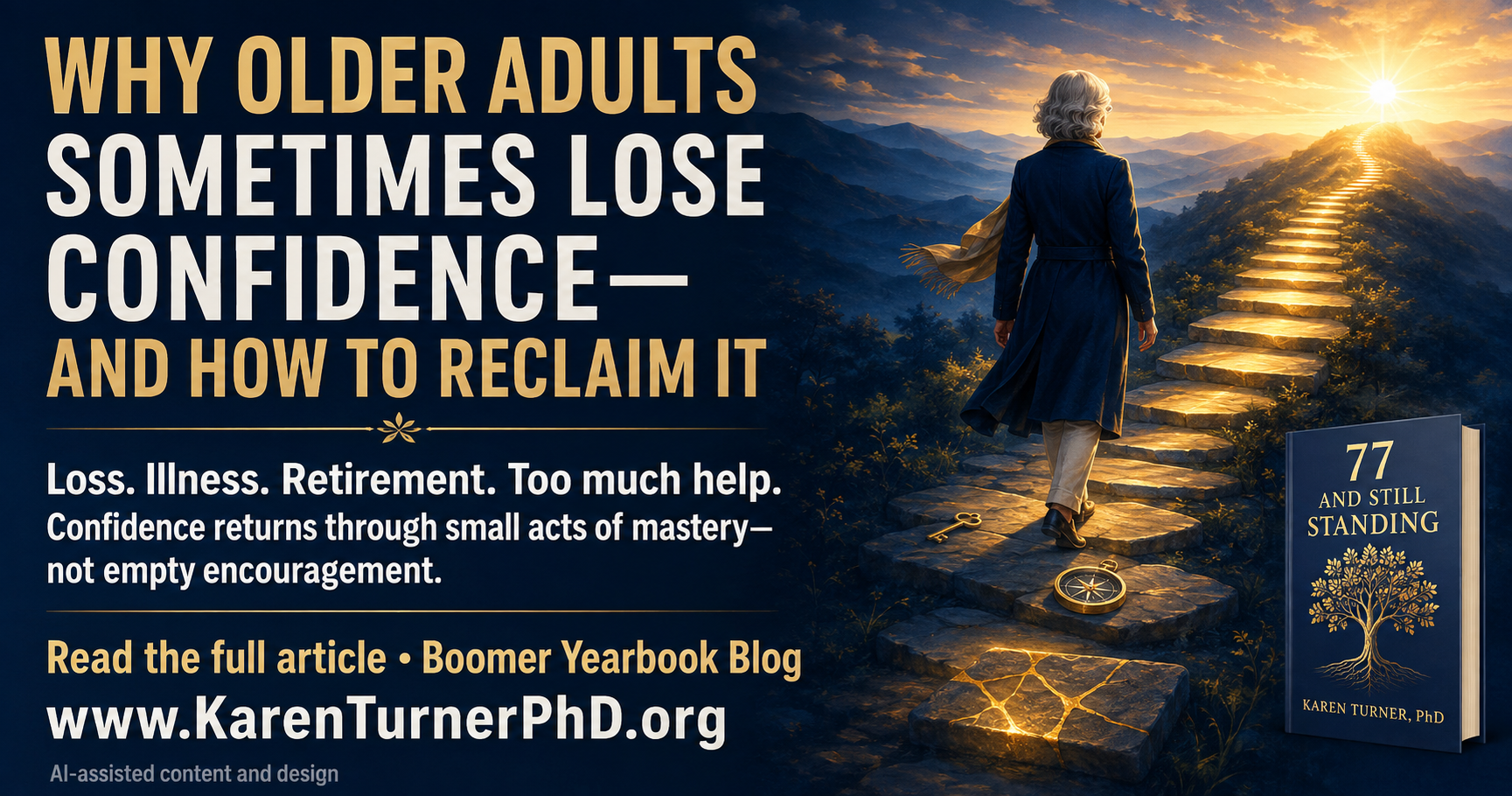
And How to Reclaim It
By Karen Turner, PhD · Published 2026-08-28 · Last updated 2026-08-28
Confidence is not a personality trait you either have or lose. It is a relationship with yourself, and relationships can be rebuilt.
You may once have made decisions, solved problems, traveled, worked, raised children, and managed crises without wondering whether you belonged in the room. Then retirement, loss, illness, a fall, unfamiliar technology, or too much help from others changed the evidence you received about yourself.
Why do older adults lose confidence? Confidence can shrink after retirement, bereavement, illness, falls, changes in mobility, social isolation, unfamiliar technology, or repeated ageist messages. It can return through small experiences of mastery, appropriate activity, connection, updated skills, and help that supports rather than replaces decision-making. Sudden or severe changes should be discussed with a health professional.
Confidence is not the same as competence
Competence is what you can do. Confidence is what you believe you can do. The two do not always match. A capable person may underestimate herself after a frightening experience, while another person may feel confident while overlooking real safety concerns. Healthy confidence is accurate self-trust.
Aging can require honest recalibration. You may need brighter light to read, more time to learn an app, a handrail on the stairs, or a second set of ears at a medical appointment. Using support does not erase competence. Often, it protects it. The goal is not to do everything exactly as you did at forty. It is to know what you can do now, what you can learn, and where support helps you remain in charge.
Why confidence can shrink with age
Retirement changes the evidence you receive
Work gives many people constant proof of usefulness: problems solved, responsibilities met, colleagues seeking advice, and skills visible to others. Retirement can remove that feedback overnight. Even welcome retirement can leave a person wondering whether what they know still matters.
Loss and health changes can make ordinary decisions heavier
The death of a spouse, friend, or sibling may remove a person who shared decisions and encouraged risks. A fall, surgery, diagnosis, or hospitalization can divide life into before and after. Fear of another event can lead to less walking, driving, travel, or connection. Avoidance reduces practice, and reduced practice lowers confidence further.
Ageism and too much help can become an inner voice
Ageism includes stereotypes, prejudice, and discrimination based on age. When families, advertising, and everyday interactions imply that older people are confused, frail, or irrelevant, people may begin to self-edit. Loving help can also become takeover: someone else makes appointments, answers questions, manages money, or speaks to the doctor. Every task removed is one less opportunity to gather evidence of competence.
The confidence-avoidance loop
- Something feels difficult or frightening.
- You avoid it or let someone else take over.
- You lose practice and recent evidence of success.
- The task feels larger the next time.
- You conclude that you are no longer capable.
The way out is not a heroic leap. It is manageable repetition.
How to reclaim confidence
| Try this | Why it works | A first small step |
|---|---|---|
| Choose one act of mastery | Completion creates evidence stronger than reassurance. | Make your own appointment or learn one phone feature. |
| Use a confidence ladder | Gradual practice makes a goal less overwhelming. | Break a trip into route planning, a practice visit, then one short journey. |
| Ask for instruction, not takeover | Good help leaves you more capable. | Say, “Show me once, then let me try.” |
| Keep an evidence file | The mind remembers embarrassment more than routine success. | Record one problem solved or decision made each day. |
| Update a skill | Unfamiliar systems are not proof of inability. | Ask a patient teacher for one clear lesson. |
Strengthen the body you live in now. Appropriate physical activity can support function, balance, mood, sleep, and daily life. The National Institute on Aging notes that activity can support function and independence. If you have been inactive or have health concerns, ask a qualified professional what is appropriate, then begin where you are.
Stay where you are expected to participate. Volunteer work, classes, faith communities, mentoring, neighborhood projects, and creative work can restore the experience of being known for more than limitations. The CDC explains that supportive social connection can foster belonging and benefit mental and physical health. Learning slowly is still learning. Beginner status is temporary. Curiosity is not age-limited.
Change absolute statements. Replace “I cannot do technology” with “I have not learned this program yet.” Replace “I am too old to start” with “I need more time and a clear explanation.” This is not empty positive thinking. It is refusing to turn one difficulty into a verdict on your entire self.
When low confidence may need professional attention
Low confidence can be part of depression, anxiety, prolonged grief, medication effects, sleep problems, pain, or a medical condition. The World Health Organization identifies bereavement, retirement, declining function, ageism, loneliness, and social isolation as important later-life mental-health factors. Talk with a health professional if a change is sudden, severe, or accompanied by persistent sadness, withdrawal, confusion, major sleep or appetite changes, or loss of interest in life.
Seek urgent help for sudden confusion, weakness, trouble speaking, severe dizziness, or other abrupt neurological symptoms. Asking for help is not evidence that confidence is gone. It may be the first act of reclaiming it.
Aging without shrinking
Confidence later in life may be quieter and better informed than youthful certainty. It knows that mistakes happen, bodies change, and help is sometimes necessary. It also knows that dependence in one area does not erase authority in every other area. You are allowed to take up time while learning, ask questions, change your mind, try again, and be visible. Confidence returns when you participate in your own life often enough to recognize yourself again.
Frequently Asked Questions
Is losing confidence a normal part of aging?
No. Aging itself does not automatically cause low confidence. Retirement, bereavement, illness, reduced practice, isolation, and ageism can affect self-trust, but confidence can be rebuilt.
Why do capable older adults begin doubting themselves?
Confidence may decline when a person receives less feedback about competence, experiences frightening mistakes or health changes, or has other people repeatedly take over. Ageist messages can also become internalized.
What is the fastest way to rebuild confidence?
Choose one small, meaningful task and practice it repeatedly with the right level of support. Confidence grows more reliably from evidence of mastery than from reassurance alone.
How can family members help without taking over?
Ask what help is wanted, keep the older adult involved in decisions and tasks, allow extra time, and do not speak for the person unless requested or necessary.
Can exercise improve confidence in older adults?
Appropriate physical activity can support strength, balance, mood, sleep, and function. Those gains can create real experiences of capability. Activity should be matched to the person’s health and abilities.
When should a sudden loss of confidence be evaluated?
Speak with a health professional when the change is abrupt, severe, or accompanied by confusion, persistent sadness, anxiety, withdrawal, sleep changes, or functional decline.
Sources and further reading
- World Health Organization: Ageism
- World Health Organization: Mental Health of Older Adults
- CDC: Social Connection
This article provides general information and is not a substitute for medical or mental health care.
Related Reading
- The Invisible Work of Being the Strong One
- Aging Alone Without Feeling Alone: A Practical Guide to Building Your Support System