Scientists have discovered something remarkable.
During pregnancy, cells pass between a mother and her baby. For many years, researchers assumed those cells disappeared after birth. Instead, studies have found that some of these cells may remain in the body for decades.
The phenomenon is called microchimerism.
The name comes from Greek mythology and refers to the presence of a small number of cells that originated from another person. Researchers have found maternal cells in adult children and fetal cells in mothers many years after pregnancy.
The science is fascinating.
The implications are even more fascinating.
As researchers continue to study microchimerism, many of us find ourselves drawn not only to the biology but also to the deeper question it raises:
What does it mean to carry pieces of another person throughout our lives?
We Are More Connected Than We Realize
Most of us think of ourselves as independent individuals.
Yet from the moment we are born, our lives are shaped by countless influences.
We carry family stories.
We carry traditions.
We carry values.
We carry lessons learned through love, hardship, success, disappointment, resilience, and recovery.
Microchimerism suggests that some of us may literally carry tiny physical traces of those who came before us.
Whether those cells remain active or simply persist as biological remnants is still being studied.
But the idea itself is powerful.
Perhaps none of us travel through life alone.
The Psychology of Being Shaped
As a psychologist, I have spent much of my career helping people understand how their past influences their present.
Our childhood experiences matter.
Our relationships matter.
The people who encouraged us matter.
The people who hurt us matter.
The people who believed in us matter.
Even decades later, those experiences continue to shape how we think, feel, and respond to the world.
Microchimerism offers a fascinating biological parallel to something psychologists have long understood:
The people who shape us never completely leave us.
Their influence continues long after specific moments have passed.
We may not consciously think about those influences every day, but they remain part of our story.
Aging Is Not Starting Over
One of the messages I return to often in 77 and Still Standing is that aging is not about becoming someone new.
It is about becoming more fully yourself.
The popular culture message often encourages reinvention.
But many of us do not need reinvention.
We need recalibration.
We need to recognize the strengths, wisdom, resilience, and experiences we have already accumulated.
We need to understand that our history is not a burden.
It is a foundation.
Like the roots of a tree, much of what sustains us lies beneath the surface.
You may not see your roots every day.
But they are there.
Supporting you.
Steadying you.
Helping you continue to grow.
Your Roots Run Deep
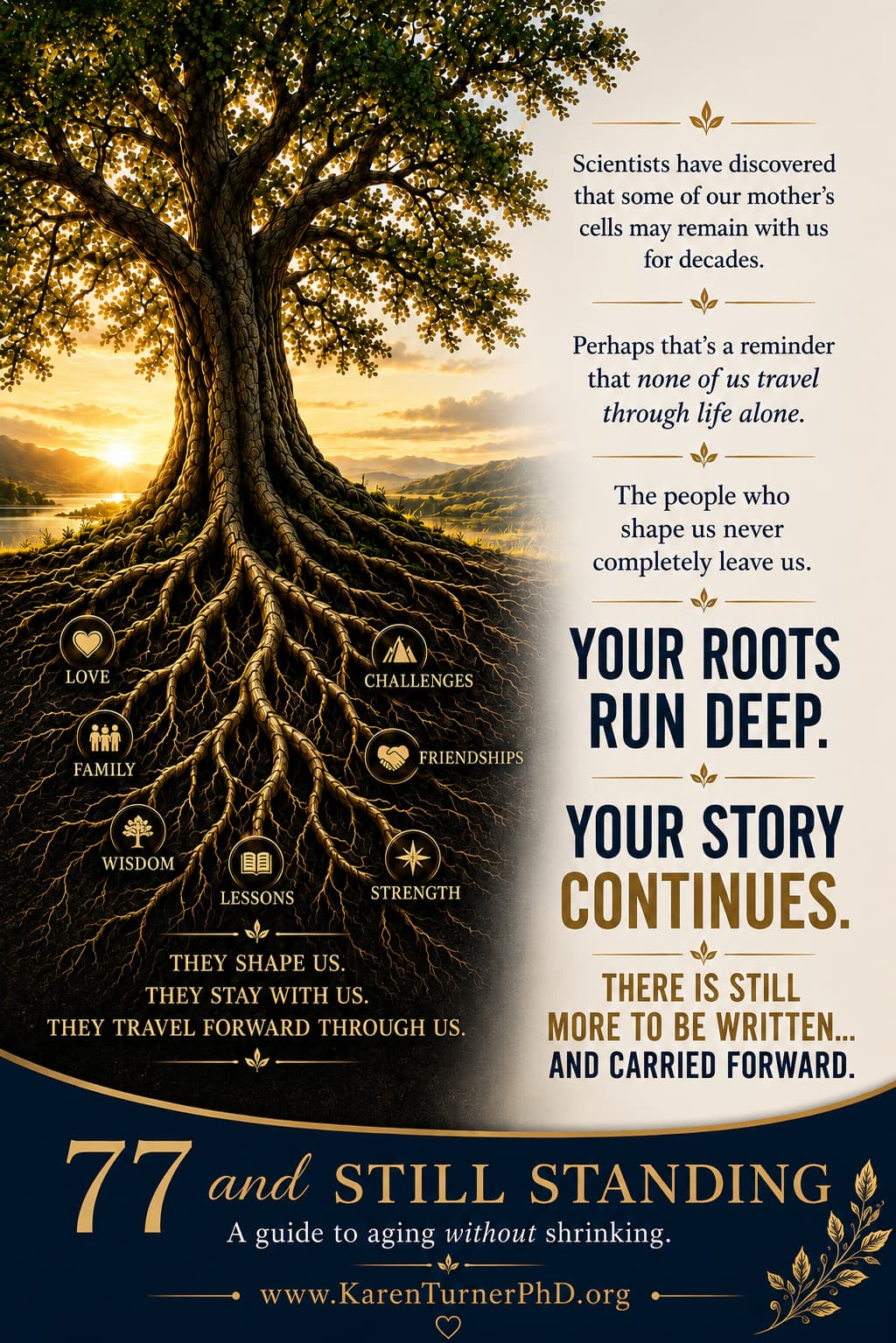
The image accompanying this article shows a tree with roots labeled:
* Love
* Family
* Wisdom
* Lessons
* Challenges
* Friendships
* Strength
Those roots represent far more than biology.
They represent the people and experiences that have shaped us.
Some roots were formed through joy.
Others were formed through loss.
Some came from triumph.
Others came from adversity.
Yet all of them contribute to who we are today.
The older I get, the more convinced I become that resilience is not something we suddenly acquire.
It develops over time.
It grows from the roots we have spent a lifetime building.
There Is Still More to Be Written
Perhaps the most beautiful aspect of microchimerism is the possibility that our connection to others extends across generations.
Researchers are even exploring whether cells may pass from grandmother to mother to child.
Whether future studies confirm every aspect of that possibility remains to be seen.
But the larger truth is already evident.
We influence one another.
Across generations.
Across decades.
Across families.
The love we give.
The lessons we teach.
The values we model.
The encouragement we offer.
These things do not end with us.
They travel forward.
They are carried by children, grandchildren, friends, students, neighbors, and countless others whose lives we touch.
That is why I find myself returning to a simple reflection:
They shape us.
They stay with us.
They travel forward through us.
And perhaps that is one of the greatest lessons of aging.
Your roots run deep.
Your story continues.
There is still more to be written—and carried forward.