

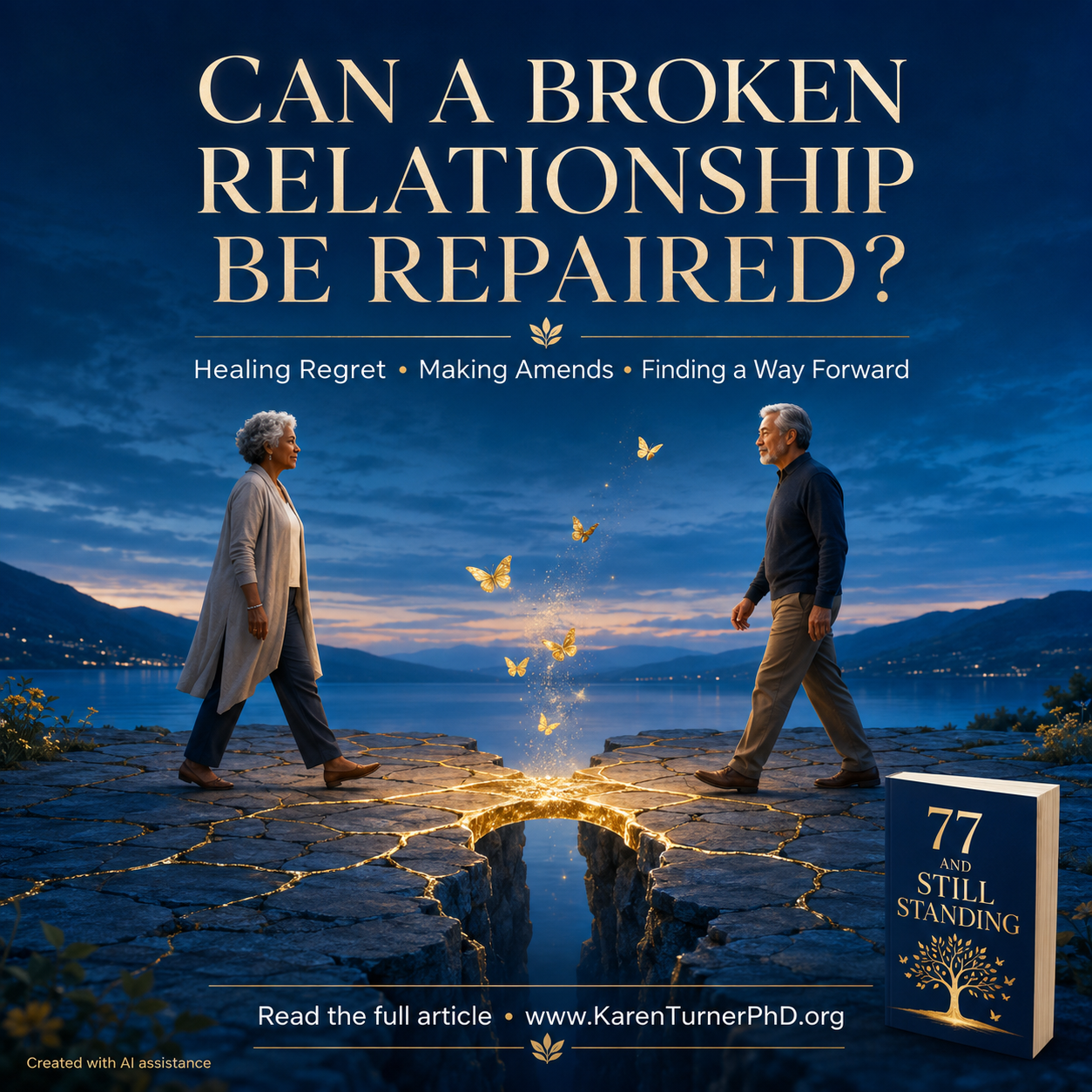
Healing regret, making amends, and finding a way forward.
Some relationships break suddenly. Others unravel through misunderstandings, words spoken in anger, divided loyalties, or years of silence. It may be an adult child, parent, sibling, former partner, or friend. The hopeful truth is that some damaged relationships can be repaired, but reconciliation cannot be forced and is not always healthy.
Quick answer: A broken relationship can sometimes be repaired when both people are willing to communicate honestly, take responsibility, respect boundaries, and rebuild trust gradually. You can make a sincere amends without demanding forgiveness or contact.
Why broken relationships can hurt more as we grow older
Later life can bring unfinished conversations into sharper focus. Retirement, illness, loss, a grandchild, or a quiet afternoon may reveal how much a relationship still matters. Perspective can make it possible to value understanding over winning an old argument.
Repair is rarely one dramatic moment. It asks for patience, humility, and choices that protect dignity on both sides. The article How to Reconnect With an Estranged Adult Child offers related guidance for family distance.
Apology, forgiveness, reconciliation, and trust are different
An apology acknowledges harm. Forgiveness is personal. Reconciliation is a mutual choice to rebuild contact. Trust returns only through consistent behavior. Keeping these distinctions clear prevents one conversation from carrying expectations it cannot meet.
Repair is rarely one dramatic moment. It asks for patience, humility, and choices that protect dignity on both sides. The article How to Reconnect With an Estranged Adult Child offers related guidance for family distance.
What should you ask before reaching out?
Ask whether you can listen without correcting the other person’s version, whether you are ready for no response, and whether you want repair or relief from guilt. A healthy aim is to take responsibility for your part and leave the other person free to decide what is possible.
Repair is rarely one dramatic moment. It asks for patience, humility, and choices that protect dignity on both sides. The article How to Reconnect With an Estranged Adult Child offers related guidance for family distance.
What does a sincere amends sound like?
Name the behavior, acknowledge its impact, accept responsibility without excuses, express regret, and do not demand forgiveness. “I was defensive and dismissed how deeply you were hurt. I am sorry. I do not expect an answer, but I wanted to take responsibility.” Avoid adding “but.”
Repair is rarely one dramatic moment. It asks for patience, humility, and choices that protect dignity on both sides. The article How to Reconnect With an Estranged Adult Child offers related guidance for family distance.
How can you reach out after years of silence?
Use one brief, contained message. A letter, email, or text gives the other person room to decide. Say that you recognize the distance, are sorry for your contribution to it, and would welcome a conversation if and when they are ready. Repeated messages can become pressure.
Repair is rarely one dramatic moment. It asks for patience, humility, and choices that protect dignity on both sides. The article How to Reconnect With an Estranged Adult Child offers related guidance for family distance.
What if you remember the past differently?
You do not need identical memories to acknowledge emotional impact. You can say that you remember parts differently while believing the other person’s pain. The useful question is not whose memory wins; it is what each person needs for a healthier relationship now.
Repair is rarely one dramatic moment. It asks for patience, humility, and choices that protect dignity on both sides. The article How to Reconnect With an Estranged Adult Child offers related guidance for family distance.
How is trust rebuilt?
Trust grows through small promises kept, privacy respected, direct communication, and steady behavior over time. Do not recruit relatives to take sides or use gifts as a substitute for accountability. A smaller, slower relationship may be safer and more realistic than trying to recreate the past.
Repair is rarely one dramatic moment. It asks for patience, humility, and choices that protect dignity on both sides. The article How to Reconnect With an Estranged Adult Child offers related guidance for family distance.
When may professional help be valuable?
A therapist, family therapist, mediator, or qualified faith leader can help when estrangement, caregiving, inheritance, addiction, grief, or repeated conflict makes direct conversation overwhelming. Professional support cannot guarantee reunion, but it can make communication safer and clearer.
Repair is rarely one dramatic moment. It asks for patience, humility, and choices that protect dignity on both sides. The article How to Reconnect With an Estranged Adult Child offers related guidance for family distance.
When may reconciliation be unhealthy?
Distance may be necessary when contact is abusive, coercive, exploitative, stalking, or repeatedly violates boundaries. Forgiveness does not require renewed access. If there is danger or fear of retaliation, seek confidential professional support before making contact.
Repair is rarely one dramatic moment. It asks for patience, humility, and choices that protect dignity on both sides. The article How to Reconnect With an Estranged Adult Child offers related guidance for family distance.
What if they do not respond?
You can offer honesty and change; you cannot control readiness or response. Respect a clear no. One final note may say that you understand and remain sorry, but continuing to contact someone who asked for space is not an amends. Healing can continue through changed behavior and support.
Repair is rarely one dramatic moment. It asks for patience, humility, and choices that protect dignity on both sides. The article How to Reconnect With an Estranged Adult Child offers related guidance for family distance.
How can you heal without reconciliation?
Write an unsent letter, speak with a therapist or clergy member, identify the pattern you want to end, and make a living amends in other relationships. Closure is sometimes a final conversation. Sometimes it is the decision to live differently because the relationship mattered.
Repair is rarely one dramatic moment. It asks for patience, humility, and choices that protect dignity on both sides. The article How to Reconnect With an Estranged Adult Child offers related guidance for family distance.
Key takeaways
- Reconciliation requires willingness from both people.
- Apology, forgiveness, reconciliation, and trust are separate processes.
- Safety and boundaries come before renewed contact.
Frequently Asked Questions
Can a broken relationship really be repaired?
Yes, when both people are willing to communicate honestly, respect boundaries, and rebuild trust over time.
Is reconciliation always the healthiest choice?
No. It may be unsafe when abuse, coercion, exploitation, or repeated boundary violations continue.
Related Reading
- When Parents Die, Siblings Inherit More Than Money
- What Happens to Friendship After 70?
- The Invisible Work of Being the Strong One
Sources and support
- American Association for Marriage and Family Therapy
- Psychology Today therapist directory
- National Domestic Violence Hotline
- 988 Suicide & Crisis Lifeline
Educational note: This article is general education, not individualized mental-health, legal, or safety advice. If you are in immediate danger, call emergency services.
Published and last reviewed: September 2026
A more grounded way forward
It can help to slow the pattern down enough to see what is actually happening. Name the feeling, the request, the history it touches, and the choice in front of you. You do not have to decide your entire future in one difficult conversation. A small, clear next step is often more protective than a grand promise made under pressure.
Try separating what you can influence from what belongs to another person. You can speak honestly, set a limit, offer repair where it is yours to offer, and choose who has access to your time and energy. You cannot make another person become curious, accountable, emotionally available, or ready before they are willing.
Practice a response before you need it
When an old pattern is activated, the body often reacts before the mind has caught up. A pause can protect you: “I need time to think about that.” “I am not ready to decide today.” “I hear that this matters to you, and I need you to hear that it matters to me too.” These sentences are not rejection. They create room for a thoughtful answer.
Write down what you want to say. Read it aloud. Remove the unnecessary apologies and explanations. Then keep the message simple. People who respect you may need time to adjust, but they do not require you to abandon yourself in order to remain connected.
Build support around the change
Change is easier when it is not attempted in isolation. A trusted friend, therapist, support group, faith leader, social worker, or qualified adviser can help you distinguish discomfort from danger and guilt from responsibility. Choose people who can be honest without repeating the old story about who you are.
Also notice where your life already contains reciprocity. Invest in the people, routines, interests, and communities that leave you steadier rather than depleted. A relationship does not have to be perfect to be valuable, but it should make room for your dignity, your needs, and your present-day self.
Let actions match your values
A boundary is not a demand that someone else agree with you. It is a decision about what you will do. You can be compassionate and still be specific about time, money, contact, privacy, or respect. Consistency matters more than a perfectly worded explanation.
Expect mixed feelings. Relief and sadness can coexist. Missing a person, a role, or an imagined future does not mean the decision to protect yourself was wrong. Give yourself time to learn a new way of relating.
Questions for the next step
- What part of this situation is mine to address?
- What am I carrying that belongs to someone else?
- What is one specific, sustainable change I can make now?
- Who can support me without taking over?
- What would respect for myself look like this week?
Growth is not proven by a single conversation or another person’s immediate approval. It is built through repeated choices that align your actions with your values.