

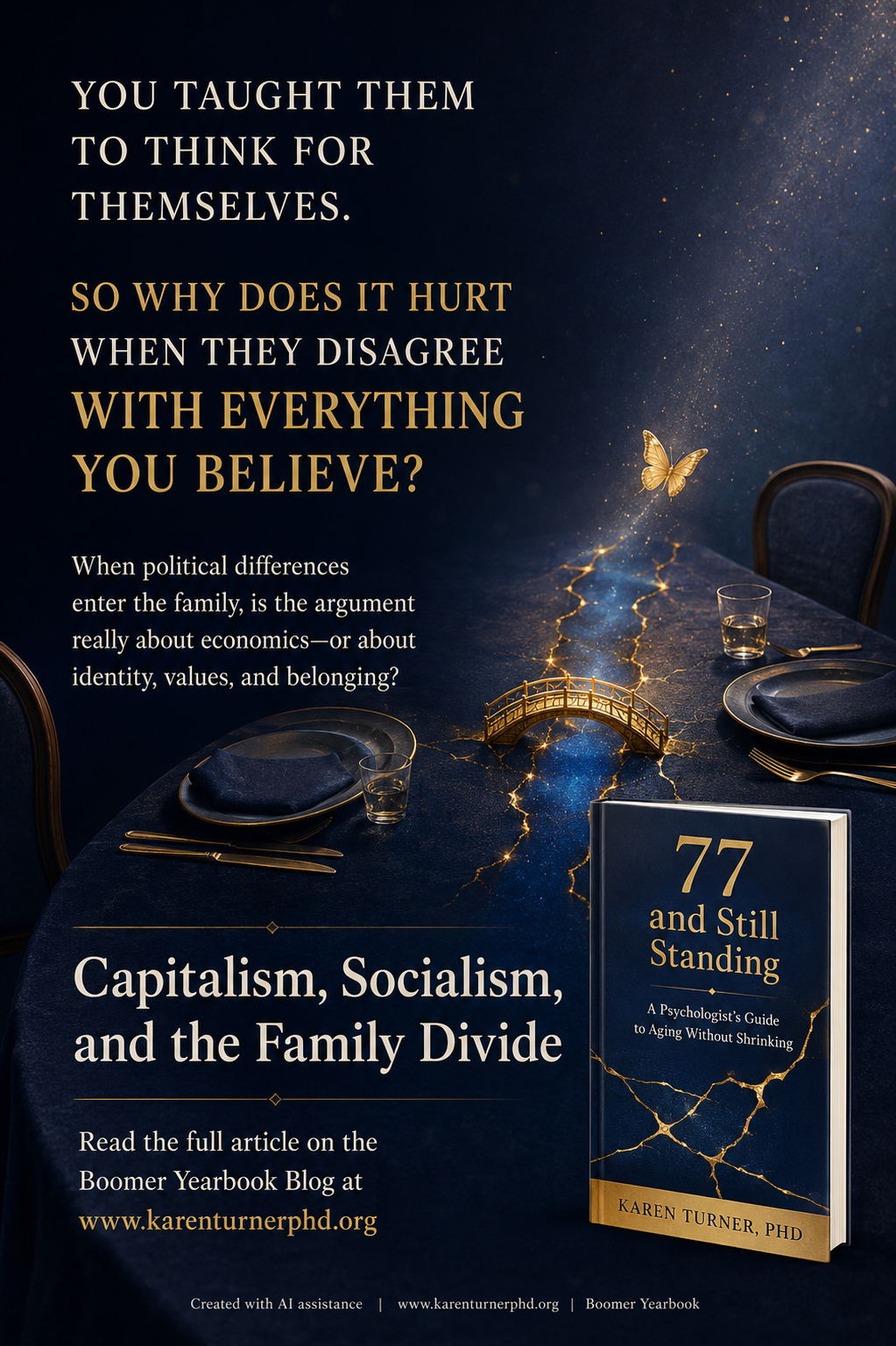
Political disagreement can sound like an argument about economics. Inside a family, it often feels like an argument about character, gratitude, fairness, and belonging.
You taught your children to think for themselves. You wanted them to ask questions, stand up for what they believed, and become adults with minds of their own. Then one day, they did, and what they believed seemed to challenge everything you had spent a lifetime learning.
Perhaps you built a business, saved carefully, worked through lean years, and came to see capitalism as the system that rewarded effort and made your family life possible. Your adult child looks at housing costs, student debt, medical bills, stagnant opportunity, or widening inequality and says the system is not working. They may speak favorably about socialism, democratic socialism, stronger public programs, or a different economic order. Suddenly, a conversation about taxes or health care becomes something much more personal.
You hear, The life you built was unfair. They hear, Your struggles are your own fault. Neither may be what was intended. Both may be what was felt.
Parents and adult children can remain close despite sharp disagreements about capitalism and socialism, but not if every conversation becomes a test of intelligence, morality, or loyalty. Understanding begins when both generations stop arguing only about labels and start asking what experiences, fears, and values the labels represent.
Is there really a generational divide over capitalism and socialism?
Yes, but it is more complicated than older people are capitalists and younger people are socialists. Pew Research Center has found a clear age pattern. Younger adults tend to view socialism more favorably and capitalism less favorably than older adults. In Pew’s 2022 survey, adults under 30 were far less likely than people 65 and older to express a positive view of capitalism. Adults under 50 were also more likely than those 50 and older to view socialism positively.
More recent international research found that younger Americans were more likely than older Americans to say the economic system needs major change or complete reform. But dissatisfaction with the current system is not the same thing as agreement about what should replace it. Some young adults favor stronger social programs within a market economy. Some distrust both capitalism and socialism. Some use the word socialism to mean universal health care, affordable education, or stronger worker protections, not government ownership of every business.
Older adults are not one political type either. Many support Social Security, Medicare, public schools, labor protections, and other collective programs while still strongly identifying with capitalism. The labels are broad. Families get into trouble when they assume the label tells them everything about the person.
Why do older and younger generations see the economy differently?
Political beliefs do not arise only from facts. They are shaped by the economy a person encountered when becoming an adult.
Many older Americans remember periods when one income could support more of a household, pensions were more common, homeownership felt attainable, and long service to an employer could produce stability. They may also remember inflation, unemployment, war, business failures, or years when nobody rescued them. To them, personal responsibility is not a slogan. It is how they survived.
Many younger adults entered adulthood in the shadow of the Great Recession, expensive housing, rising tuition, insecure employment, medical costs, and a digital economy in which enormous wealth can appear disconnected from ordinary labor. To them, structural inequality is not an excuse. It is what they see around them.
Different starting conditions produce different lessons. An older parent may think, I worked hard and built a life. An adult child may answer, I work hard too, but the ladder you climbed has been pulled farther away. Both statements can contain truth.
Why does a political disagreement feel like a personal rejection?
Because economic beliefs often carry a moral story. Capitalism may represent independence, discipline, freedom, creativity, and the dignity of earning one’s way. Socialism may represent solidarity, fairness, protection from catastrophe, and the belief that no one should be abandoned. When either word is attacked, the person may feel that their moral character is being attacked with it.
Parents can experience a child’s politics as ingratitude. After everything we sacrificed, how can you condemn the system that allowed us to provide for you? Adult children can experience a parent’s politics as indifference. How can you defend a system that leaves people my age unable to afford the life you had?
Beneath the argument may be a more vulnerable question. The parent is asking, Do you respect the life I built? The child is asking, Do you understand the life I am trying to build? Families rarely resolve the conflict while those questions remain unspoken.
Are families actually disagreeing about definitions?
Often. Capitalism can mean small business freedom to one person and corporate domination to another. Socialism can mean authoritarian state control to one person and Scandinavian style social insurance to another. Two people may fight bitterly while imagining different systems.
Before debating, ask for a definition. When you say capitalism, what parts are you defending? When you say socialism, what policies do you actually mean? Move from identity words to concrete questions about housing, wages, health care, taxes, education, entrepreneurship, retirement, regulation, and the safety net.
You may discover more overlap than the labels suggested. A parent who prizes markets may still oppose monopolies and exploitation. A child who favors public programs may still value private enterprise, ownership, and innovation. Agreement is not guaranteed, but accuracy is possible.
What does each generation often misunderstand about the other?
Older adults may mistake frustration for laziness. A younger person criticizing the economy may be working several jobs, delaying marriage or children, or watching homeownership recede despite doing what they were told. Their critique may come from effort that has not produced security, not from refusal to work.
Younger adults may mistake an older person’s defense of capitalism for selfishness. That parent may associate economic freedom with escaping poverty, starting a business, surviving political oppression, or refusing dependence. Their loyalty may come from lived gratitude, not disregard for suffering.
Both generations can become unfair when they reduce the other to an internet stereotype, the entitled socialist child or the greedy capitalist parent. Contempt simplifies the person until empathy is no longer required.
How can parents and adult children talk about politics without damaging the relationship?
A productive conversation needs a different goal. If the goal is surrender, someone must lose. If the goal is understanding, both people can leave with dignity.
- Ask about experience before ideology. Try, What has happened in your life that makes this issue important to you?
- Define the words. Do not debate capitalism, socialism, freedom, or fairness until you know what the other person means by the term.
- Discuss one policy at a time. A conversation about prescription costs is more manageable than a verdict on the entire economic system.
- Reflect before rebutting. Say what you think you heard, then let the other person correct you.
- Name shared values. You may disagree about the method while both wanting dignity, opportunity, responsibility, security, and a future for the next generation.
- Know when to stop. When voices rise, sarcasm begins, or the conversation becomes a character trial, pause.
What should you avoid saying?
- You have no idea how the real world works.
- Your generation ruined everything.
- You only believe that because you are lazy, selfish, brainwashed, privileged, or old.
- If you loved this family, or this country, you would agree with me.
- After everything I paid for, you owe me more respect than this.
- I cannot have a relationship with anyone who votes or thinks that way.
These statements do more than criticize an opinion. They attack competence, identity, and belonging. Once the conversation becomes humiliating, the economic issue is no longer the main problem.
Can you set boundaries around political conversations?
Yes. Closeness does not require unlimited access to every subject. A boundary can protect the relationship when political discussion repeatedly becomes cruel, obsessive, or destabilizing.
A respectful boundary
I love you, and I want us to remain close. Our political conversations have become painful and unproductive, so I am not willing to debate this at family meals or exchange political posts by text. I am willing to talk about our lives, listen respectfully when something truly matters to you, and stop when either of us feels attacked.
A boundary is not a punishment and should not be used to demand ideological silence from only one side. It is an agreement about behavior, no insults, no baiting, no hostile social media tagging, no political interrogation, and no turning every family event into a referendum.
What if political disagreement is threatening the relationship?
Ask whether the conflict is truly about tax rates or whether politics has become a container for older injuries. A child who has long felt dismissed may experience political disagreement as one more example of not being heard. A parent who has long felt unappreciated may experience criticism of capitalism as criticism of every sacrifice they made.
If conversations repeatedly end in rage, withdrawal, or threats of estrangement, a family therapist may help separate the policy dispute from the relationship pattern. The purpose is not to appoint an expert who decides which ideology is correct. It is to create enough emotional safety for two adults to disagree without destroying trust.
There are also limits. Political language that degrades a family member’s race, religion, sexuality, disability, immigration history, or basic humanity is not merely an abstract policy disagreement. People are entitled to protect themselves from demeaning or threatening treatment. Reconciliation should never require tolerating abuse.
Do parents and adult children need to agree in order to stay close?
No. They need something more modest and, in some ways, more difficult: the ability to recognize the other’s humanity while remaining unconvinced.
You can say, I understand why you believe that, without saying, I agree. You can ask a sincere question without preparing a trap. You can decline a debate without withdrawing love. You can allow your adult child to become politically different without treating that difference as proof that your parenting failed.
What if your child’s beliefs feel like a rejection of everything you taught them?
Remember what you taught beneath the politics. Perhaps you taught courage, compassion, independence, honesty, work, generosity, or responsibility. Your child may be applying those values differently from you. That can be painful, but it is not necessarily betrayal.
The child who questions capitalism may be acting from the compassion you taught. The parent who defends it may be acting from the independence they learned through hardship. The argument becomes less threatening when both can say, I see the value you are trying to protect, even though I disagree with your solution.
The heart of the divide
Your child’s political beliefs are not necessarily a rejection of how you raised them. They may be an attempt to answer the same questions about security, dignity, opportunity, and fairness from a very different life experience.
Can the family become more important than winning?
It can, but only if both generations stop using love as leverage. A parent should not demand political agreement as repayment for sacrifice. An adult child should not require ideological perfection as the price of relationship. Neither should confuse a vote, a label, or a news source with the whole person.
The purpose of family is not to eliminate difference. It is to create a place where difference can exist without humiliation. That does not mean abandoning convictions. It means holding convictions without shrinking the humanity of the person across the table.
You taught them to think for themselves. The final lesson may be learning to love the person who did, even when their conclusions are not your own.
Frequently Asked Questions
Why are younger adults more open to socialism?
Younger adults have come of age amid high housing and education costs, economic insecurity, and concern about inequality. Some use socialism to describe stronger public programs rather than complete state ownership. Younger adults also hold diverse views; not all reject capitalism or support the same policies.
Why do many older adults defend capitalism?
Many older adults associate capitalism with independence, upward mobility, entrepreneurship, property ownership, and the ability to build security through work. Personal hardship, business experience, or memories of authoritarian systems may also shape that view.
Can families stay close when they disagree politically?
Yes. Closeness is more likely when people define terms, discuss one issue at a time, ask about lived experience, avoid contempt, and stop conversations before disagreement becomes humiliation or coercion.
What should I say when my adult child criticizes capitalism?
Ask what experiences and policies are behind the criticism. Reflect what you heard before explaining your view. You might say, I want to understand what you believe is failing and what you would change.
How do I set a boundary around political conversations?
Describe the behavior you will not participate in, such as insults, baiting, or political debates at family meals, and state what you remain willing to do. Apply the boundary consistently to everyone, including yourself.
Is political disagreement a valid reason for estrangement?
Political difference alone does not require estrangement. However, threats, harassment, dehumanizing language, abuse, or attacks on a person basic identity may justify stronger boundaries. Safety and dignity matter more than forced contact.
Can family therapy help with political conflict?
Family therapy may help when political arguments reflect deeper patterns of dismissal, resentment, control, or feeling unseen. A therapist should help the family communicate safely, not decide which political ideology is correct.
Educational note: This article offers general psychological and relationship education. It is not therapy, political advocacy, economic advice, or a substitute for individualized professional care when conflict involves abuse, threats, or safety concerns.
Research Sources
Read the full article on the Boomer Yearbook Blog at www.karenturnerphd.org