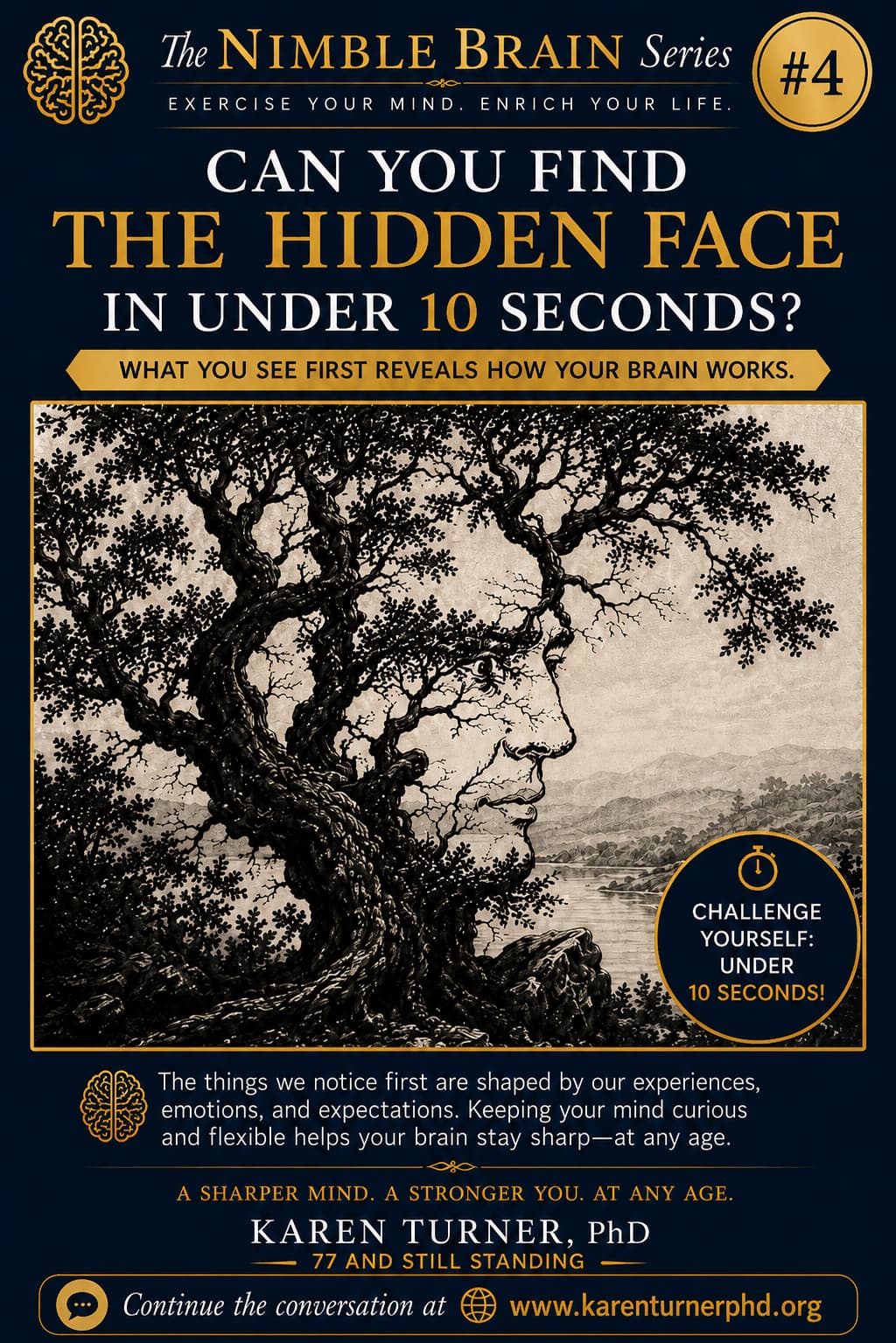
What you notice first in an optical illusion says something real about how your brain is currently working, and training that flexibility is one of the quiet foundations of healthy aging. At first glance, the image below may look like nothing more than a tree: branches, shadows, twisted bark. Then suddenly, almost without warning, a face appears. Once you see it, you cannot unsee it.
Why Does What We Notice First Say So Much About Us?
That moment matters more than people realize, because optical illusions are not simply games. They are small demonstrations of how the human brain works. What we notice first is shaped by experience, emotion, expectation, habit, and sometimes even stress. Two people can look at the exact same image and see entirely different things: one person immediately spots the hidden face, another sees only trees, another notices the landscape first, another becomes frustrated and gives up quickly. The brain is not merely recording reality. It is interpreting it, and that interpretation is deeply connected to psychological flexibility.
What Is Cognitive Flexibility, and Why Does It Matter for Aging?
Cognitive flexibility is the brain’s willingness to keep searching for another perspective rather than settling for the first answer. In many ways, it is one of the quiet foundations of healthy aging: not perfection, not speed, not genius, but flexibility. For years, many people have been taught to think about aging primarily in terms of decline: memory loss, slowing down, limitations. But modern psychology and neuroscience increasingly suggest something more hopeful. The brain remains remarkably capable of adaptation throughout life. Neural pathways continue developing, new connections can still form, attention can still sharpen, and curiosity can still expand the mind. In fact, many older adults develop strengths that younger people often lack:
- Improved pattern recognition
- Emotional insight
- Better judgment
- Deeper intuition
- Greater tolerance for complexity
The aging brain is not simply losing abilities. In many cases, it is reorganizing them, and that distinction matters, because the way people think about aging often shapes how they experience it. If people begin seeing themselves as mentally “finished,” they often stop challenging themselves, stop learning, stop exploring, and stop engaging, and slowly the world becomes psychologically smaller.
How Can Something as Simple as an Optical Illusion Help?
The mind thrives on stimulation, not frantic overstimulation, not endless scrolling, not noise, but meaningful engagement: puzzles, conversation, reading, reflection, learning, creativity, novelty. Even something as simple as searching for a hidden face in an image encourages the brain to scan differently, reconsider, and stay mentally active. That process is valuable at every age.
There is also something psychologically revealing about optical illusions themselves. They remind us that perception is rarely absolute. Human beings often assume that the way they see the world is the way the world truly is. But perception is filtered through memory, personality, emotional history, fear, hope, and past experiences. Sometimes we miss what is directly in front of us because our minds are trained to look elsewhere, and that is true in relationships, families, aging, and identity.
What Is the Hidden Face Really a Symbol Of?
Many people spend decades focused entirely on responsibility and survival. Then later in life, they suddenly begin noticing parts of themselves that had long been hidden beneath obligation: a quieter desire, a creative side, a longing for peace, a need for boundaries, a wish to finally become more fully themselves. In that sense, perhaps the hidden face in the image is symbolic too. Sometimes life asks us to look again.
A nimble brain is not necessarily the fastest brain. It is the brain willing to remain open to new information, open to reconsidering old assumptions, open to learning and growth. That kind of mental flexibility often becomes one of the greatest emotional assets of later life. And contrary to cultural stereotypes, many people become psychologically wiser with age, not less relevant. They become less reactive, less performative, less consumed with proving, but often more observant, more reflective, and more emotionally accurate.
The Takeaway
The goal is not simply to stay busy. The goal is to stay engaged with life: to keep noticing, questioning, exploring, and thinking. Growing older should never require shrinking intellectually, emotionally, or psychologically. So, did you find the hidden face in under 10 seconds? More importantly: what else might your mind be capable of seeing when it stays curious?
This article is part of our Nimble Mind Series, which explores how optical illusions and mental agility support healthy aging. See also What Do You See First? The Aging Brain Still Loves Surprise, What Do You See First? The Psychology Behind Optical Illusions and a Nimble Mind, and Aging Is Not a Straight Line: Why a Nimble Mind Matters More Than Ever.