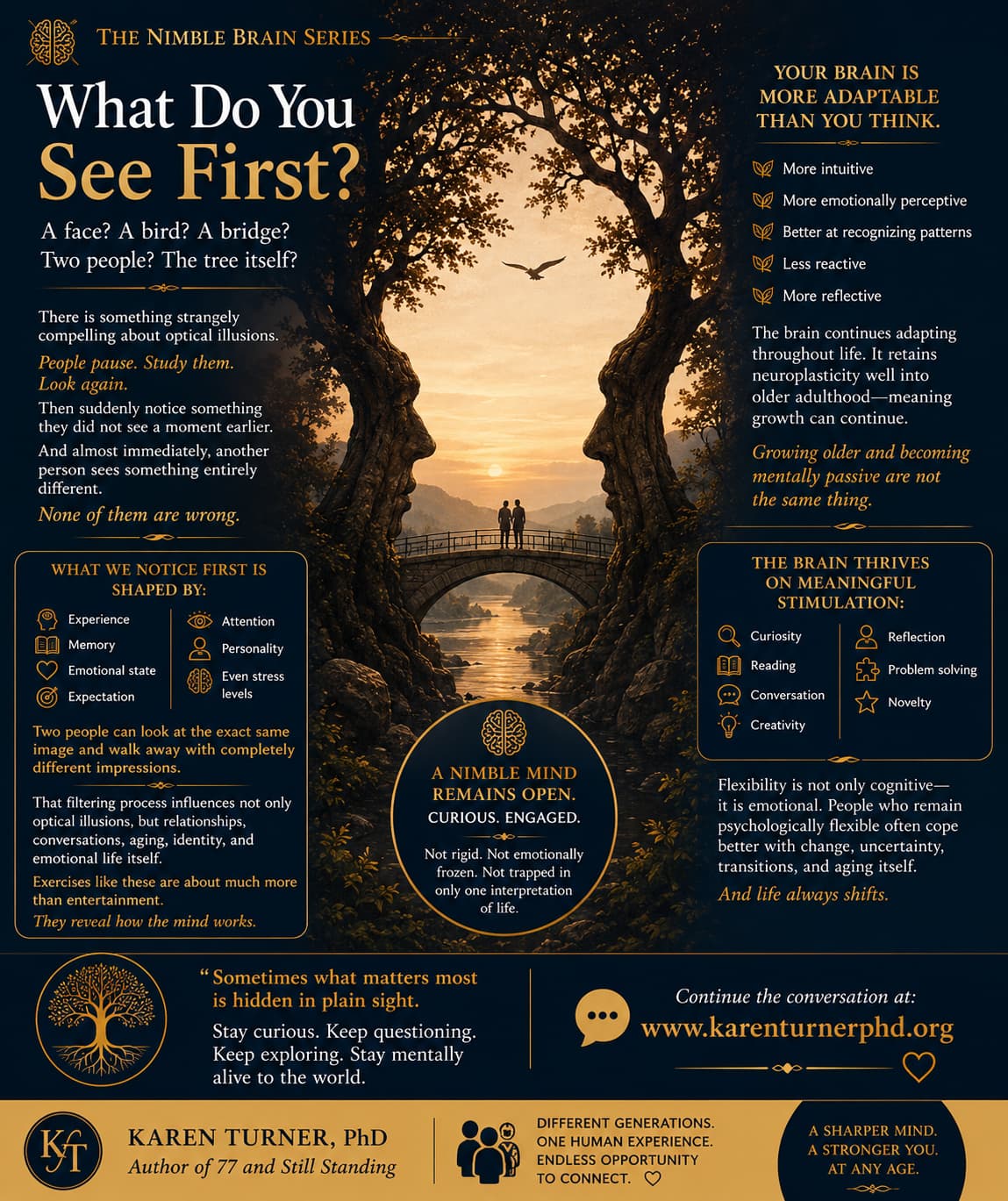
Cognitive flexibility, the brain’s ability to shift perspectives and adapt to new information, is not a fixed trait. It is a skill you can actively train at any age, and optical illusions are one of the simplest ways to practice it. What do you see first when you look at an image like this? A face? A bird? A bridge? Two people? The tree itself? People pause, study it, look again, then suddenly notice something they did not see a moment earlier, and almost immediately, another person sees something entirely different.
What Is Cognitive Flexibility, Exactly?
In psychology, cognitive flexibility refers to the brain’s ability to shift perspectives, adapt to new information, and reconsider assumptions. It is one of the most important ingredients of emotional resilience and healthy aging. A nimble mind stays open, curious, and engaged: not rigid, not emotionally frozen, not trapped in a single interpretation of life. Human beings often assume they are seeing reality exactly as it is, but the brain does not simply record the world. It interprets it. What we notice first is shaped by experience, memory, emotional state, expectation, attention, personality, and even stress levels. Two people can look at the exact same image and walk away with completely different impressions, and none of them are wrong. That filtering process influences not only optical illusions, but relationships, conversations, aging, identity, and emotional life itself.
Can You Actually Train Cognitive Flexibility as You Get Older?
Yes. Contrary to popular belief, the aging brain is often far more capable than culture gives it credit for. Modern neuroscience increasingly supports the idea that the brain retains neuroplasticity well into older adulthood, meaning new neural connections can continue forming, learning can continue, and growth can continue. The human mind was never designed to stop evolving at a certain birthday. Many older adults become more intuitive, more emotionally perceptive, better at recognizing patterns, less reactive, and more reflective. There is an important distinction between growing older and becoming mentally passive. Those are not the same thing. A person can age chronologically while remaining intellectually alive, emotionally curious, and psychologically engaged.
Simple Ways to Practice Cognitive Flexibility
One of the quiet dangers of later life is not aging itself. It is narrowing: narrowing routines, narrowing conversations, narrowing experiences, narrowing expectations. Many people slowly stop challenging the brain without even realizing it, and life becomes repetitive, predictable, and mentally smaller. The brain thrives on stimulation, not frantic overstimulation, not endless noise, not constant distraction, but meaningful stimulation. A few ways to build the habit:
- Study an optical illusion or puzzle for a few minutes and consciously look for a second interpretation
- Read something outside your usual opinions or interests
- Have a real conversation with someone who sees things differently than you do
- Try solving a familiar problem in an unfamiliar way
- Practice noticing when you have already decided you are “right,” and pause to ask what you might be missing
Even a simple optical illusion invites the brain to pause and search differently. It asks the mind to reconsider what it thought it was seeing, and that process is psychologically healthy, because flexibility is not only cognitive. It is emotional too. People who remain psychologically flexible often cope better with change, uncertainty, transitions, and aging itself. They are more capable of adjusting when life shifts unexpectedly, and life always shifts.
Why Does Mental Flexibility Matter So Much Emotionally?
There is also something deeply symbolic about these illusions. Sometimes what matters most is hidden in plain sight. A person can spend decades moving quickly through life without fully noticing themselves: always managing responsibilities, always caretaking, always adapting to everyone else’s needs. Then later in life, they suddenly begin seeing things they overlooked for years, including exhaustion, loneliness, longing, creativity, wisdom, emotional truth, the desire for peace, and the need for boundaries. Sometimes the hidden image is not in the picture. Sometimes it is within ourselves. Perhaps that is why these illusions resonate so strongly. They remind us that perception can change, and when perception changes, life often changes too.
The Takeaway
A nimble brain is not necessarily the fastest brain. It is the brain willing to remain open to growth, learning, and reexamining old assumptions. That kind of flexibility becomes increasingly valuable with age, because growing older should never require becoming psychologically smaller. The goal is not simply preserving memory. It is preserving curiosity: the willingness to keep noticing, keep questioning, keep exploring, and stay mentally alive to the world. So, what did you see first, and what else might become visible when you deliberately practice looking again?
This article is part of our Nimble Mind Series on optical illusions and mental agility. For a different angle, see What Do You See First? The Aging Brain Still Loves Surprise, Can You Find the Hidden Face in Under 10 Seconds?, and Aging Is Not a Straight Line: Why a Nimble Mind Matters More Than Ever.