

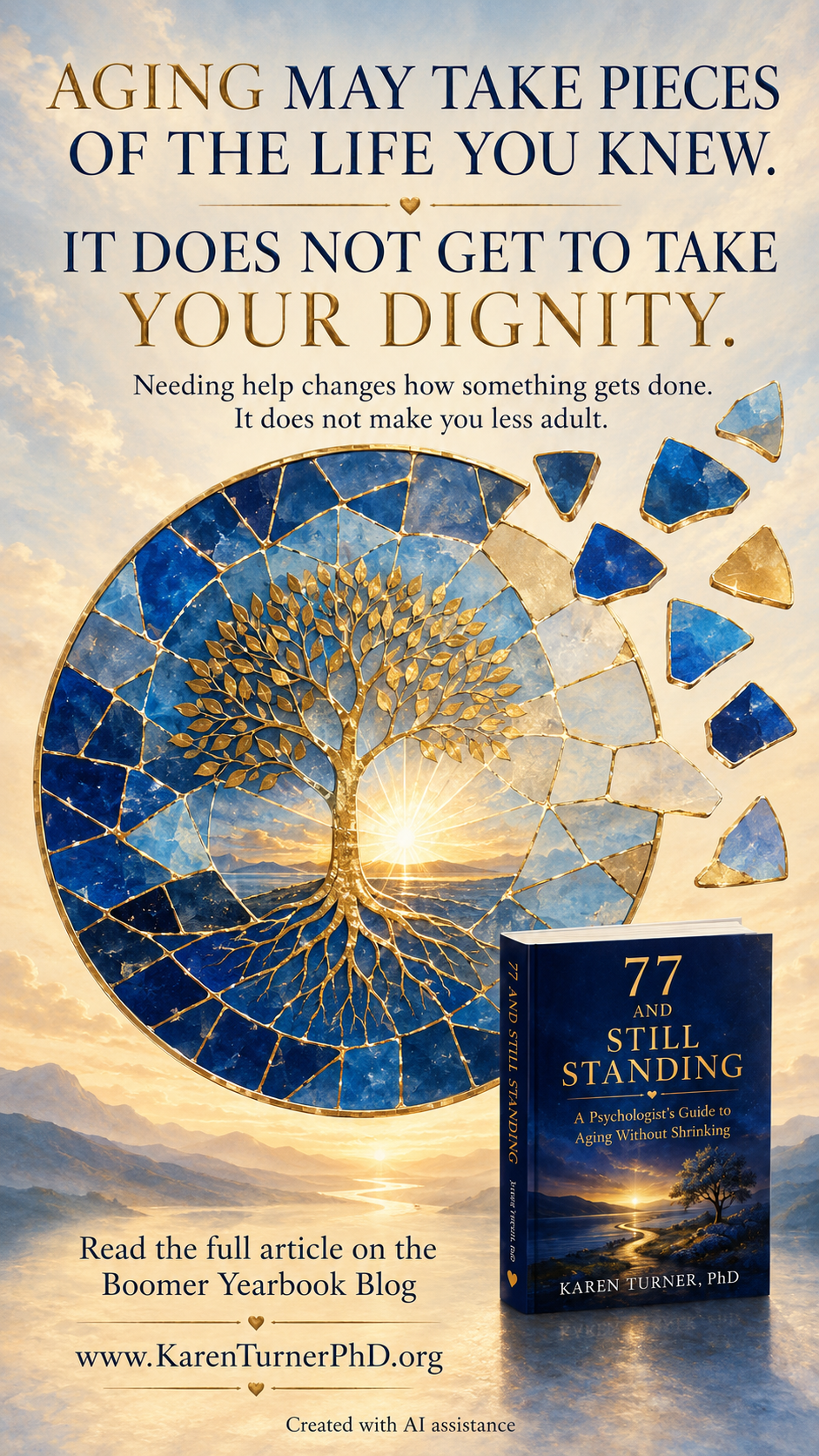
Aging rarely changes a life all at once. More often, it removes one familiar piece at a time.
A career ends. A spouse dies. The house becomes too difficult to manage. Driving no longer feels safe. A body that once moved without thought begins asking for assistance. Adult children start offering opinions about decisions that once belonged entirely to you.
Each change may look manageable from the outside. Together, however, they can create a frightening question: If I can no longer do everything I once did, am I still fully myself?
The answer is yes.
The life you knew may change. Your roles may change. Your strength, speed, memory, income, mobility, or independence may change. But dignity is not a reward for remaining unchanged. It is not something you earn by being productive, attractive, healthy, useful, or completely self sufficient.
Dignity belongs to you because you are a person. Aging cannot revoke it.
To preserve dignity while aging, separate your worth from what you can still do. Name genuine losses without allowing them to define your identity. Accept necessary help while continuing to make choices, express preferences, maintain privacy, and participate in decisions about your own life.
Dignity does not require complete independence. It requires voice, respect, choice, and recognition.
What Does Dignity Mean in Later Life?
Dignity is often confused with independence. They are related, but they are not identical.
Independence means being able to perform tasks without assistance. Autonomy means having a meaningful voice in what happens to you. A person may need help bathing, managing medication, preparing meals, or handling transportation and still retain autonomy.
You may not be able to do everything alone. You can still be consulted. You can still make choices. You can still say yes, no, not yet, or I would prefer something different.
Needing help changes how something gets done. It does not erase your right to decide how you want to live.
The Pieces We May Grieve
- The professional role that once supplied status, structure, and purpose
- The physical strength or mobility that made spontaneity possible
- A marriage, partnership, friendship, or familiar social world
- The home that held decades of memories
- Financial freedom or confidence after a spouse’s death
- The ability to drive, travel alone, or manage every task without assistance
- A caregiving role that once made you feel needed
- A familiar appearance or relationship with your body
- The assumption that your adult children would always treat you as the parent
These losses deserve to be named. Pretending they do not matter is not strength. Grief is often the mind’s way of acknowledging that something mattered deeply.
But grief and dignity can exist together. You can mourn what has changed without deciding that your best self has disappeared.
Seven Ways to Hold On to Your Dignity and Identity
1. Name the Loss Without Making It Your Identity
There is a difference between saying, ‘I can no longer drive,’ and saying, ‘I am helpless.’ The first statement names a change. The second turns that change into an identity. Use language that is accurate but not annihilating. You are a person experiencing a limitation, not a limitation pretending to be a person.
2. Separate Ability From Worth
A culture that prizes speed, productivity, appearance, and independence can make older adults feel that needing help is a personal failure. It is not. Your value was never created solely by your paycheck, physical strength, attractiveness, memory, or ability to care for everyone else.
3. Accept Help Without Surrendering Your Voice
Accepting assistance can preserve independence rather than destroy it. Transportation may allow you to remain socially connected. A medication organizer may support your health. Help with household tasks may allow you to remain in your home longer. The crucial question is whether the help respects your preferences and keeps you involved in decisions.
4. Protect the Choices That Still Belong to You
Choice is one of the strongest protectors of dignity. Even when major circumstances cannot be changed, smaller decisions still matter. A life does not have to be completely unrestricted to remain self directed.
5. Reclaim Identity Beyond the Roles You Lost
Retirement, widowhood, illness, or changing family relationships can remove the roles that once answered the question, Who am I? Instead of asking only what role has ended, ask what qualities remain. Identity can be carried forward in a new form.
6. Refuse Ageist Treatment, Including From People Who Love You
Loss of dignity often occurs not because of aging itself, but because other people begin speaking over an older adult, making decisions without consultation, using a patronizing tone, or treating reasonable risk as unacceptable simply because of age. Safety matters, but so do privacy, purpose, pleasure, and choice.
7. Build a Life Around What Is Still Possible
A meaningful later life is not created by denying limitations. It is created by refusing to let limitations occupy the entire landscape. The goal is not to recreate the exact life you had at 40, 55, or 65. The goal is to design a life that still feels recognizably yours.
When Adult Children Begin Taking Over
Adult children often step in because they are frightened. They may notice a fall, a missed payment, a driving concern, or a change in memory and immediately try to eliminate every possible risk.
Their concern may be loving. Their approach may still feel humiliating.
A productive conversation can begin with two truths: the older adult’s safety matters, and the older adult’s dignity matters. Neither should automatically erase the other.
- What are you most concerned about?
- What are you most afraid of losing?
- Which decisions do you want to continue making independently?
- What kind of help would feel supportive rather than controlling?
- Can we try the least restrictive solution first?
How Families and Caregivers Can Protect an Older Adult’s Dignity
- Speak directly to the older adult, not merely about them.
- Ask before helping whenever possible.
- Offer real choices instead of presenting a decision that has already been made.
- Do not use a childish or patronizing tone.
- Respect privacy, personal belongings, relationships, and routines.
- Explain concerns clearly without using fear as a weapon.
- Support reasonable risk instead of demanding perfect safety.
- Remember that needing more help does not make someone less adult.
Grief Is Expected. Disappearance Is Not.
It is normal to grieve meaningful losses. But persistent hopelessness, worthlessness, withdrawal, loss of interest, major sleep or appetite changes, or thoughts of death deserve professional attention.
Depression is not an inevitable or normal part of aging, and it is treatable. A physician or mental health professional can help distinguish grief, depression, medication effects, medical illness, and other causes of emotional change.
You Are Still the Author
You may not control every change that aging brings. None of us does.
But you can continue to insist on being recognized as a full person, someone with history, preferences, boundaries, humor, sexuality, intelligence, contradictions, and the right to participate in decisions.
Aging may take pieces of the life you knew. It does not get to take your dignity.
And as long as your voice remains part of the story, the next chapter can still belong to you.
Frequently Asked Questions
How can older adults maintain dignity as they lose independence?
Older adults can maintain dignity by staying involved in decisions, expressing preferences, preserving privacy, accepting only the help that is needed, and separating personal worth from physical ability or complete independence.
Is accepting help the same as losing independence?
No. Appropriate help can preserve independence by making it possible to remain at home, participate in activities, manage health, and stay socially connected. The help should support the person’s choices rather than automatically replace them.
What is the difference between independence and autonomy?
Independence means performing tasks without help. Autonomy means having a meaningful voice and control over decisions. A person may require practical assistance and still retain autonomy.
How should adult children discuss safety concerns with an aging parent?
Begin by asking about the parent’s goals and fears. Describe specific concerns without using threats, offer several options, and try the least restrictive solution that reasonably addresses the risk.
How can caregivers preserve an older person’s dignity?
Speak directly to the person, ask permission before helping, offer choices, respect privacy and routines, avoid patronizing language, and include the person in decisions about care, finances, housing, and daily life.
Is depression a normal part of aging?
No. Older adults may face losses that increase the risk of depression, but depression is not a normal part of aging. Persistent symptoms should be discussed with a physician or mental health professional.
Educational note: This article offers general guidance only, not individualized medical, mental health, legal, or care advice.
Last reviewed: 2026-08-26
Related Reading
- What Does It Really Mean to Age Well?
- When Helping Your Adult Children Begins to Hurt You
- How to Reconnect With an Estranged Adult Child
- A Living Will: Long Term Health Insurance
- What to Do Financially When Your Spouse Dies
Sources
- World Health Organization — person-centered and integrated care for older people
- World Health Organization — changing how we think, feel, and act toward age and aging
- Centers for Disease Control and Prevention — depression and aging
- National Institute on Aging — healthy aging tips and maintaining quality of life
- National Institute on Aging — participating in meaningful activities as you age