

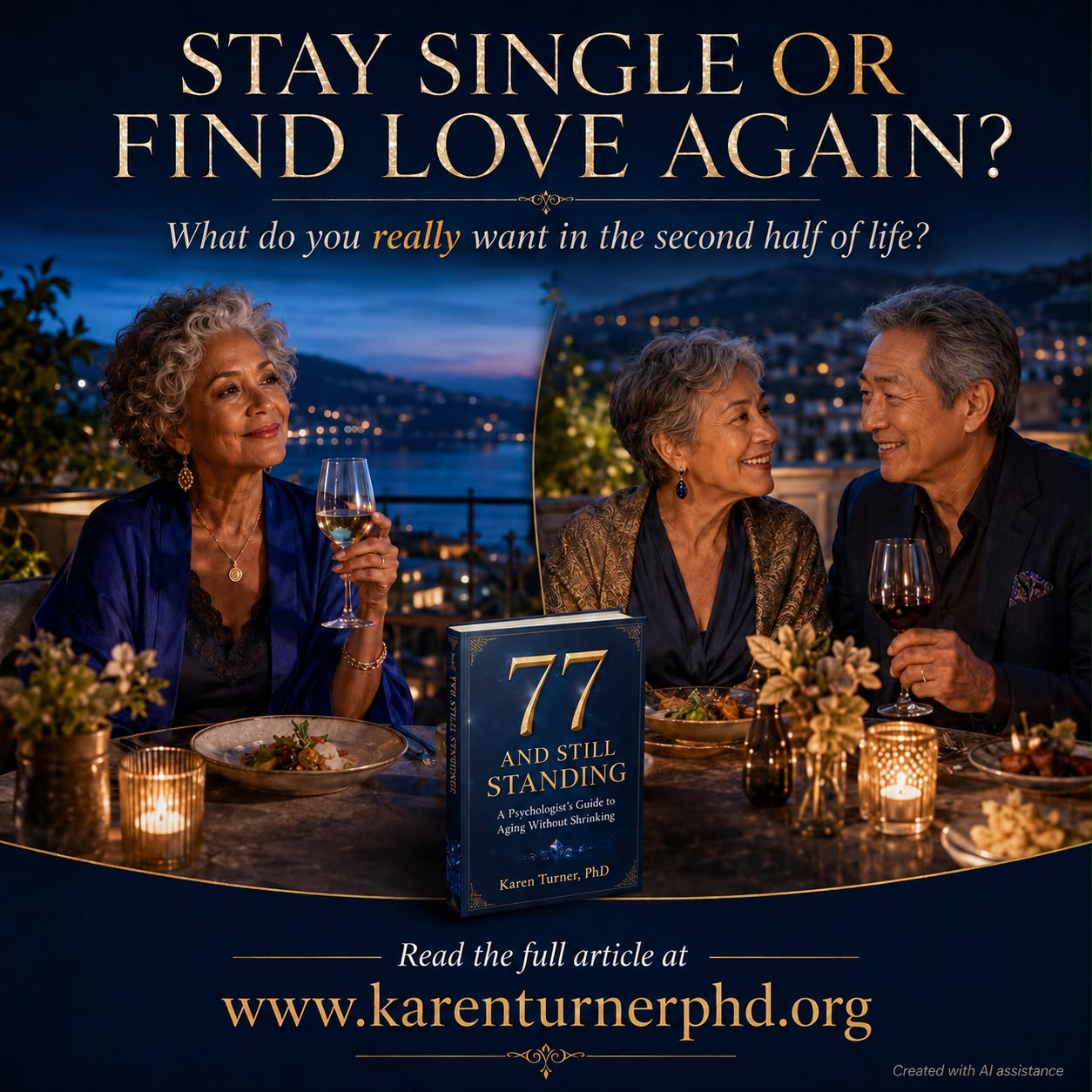
A Psychologist Explains How to Tell What You Actually Want in the Second Half of Life
There is a persistent cultural message that being partnered is better than being single. A romantic relationship is treated as evidence that a life is complete, while being single is framed as a temporary condition that ought to be corrected.
But in the second half of life, the question is not whether you can find another partner. The more important question is whether you genuinely want one.
After decades of relationships, responsibilities, compromises, caregiving, marriage, divorce, or widowhood, most people have earned a clear understanding of what supports their well-being and what quietly erodes it. Some want the intimacy and companionship of another loving relationship. Others discover they are happier living independently. Many want something in between.
There is no emotionally superior choice here. A meaningful later life can include romantic love, but it does not require it. The goal is not to prove you are happy alone, or to find someone because other people believe you should. It is to build a life that feels emotionally honest and genuinely right for you.
Is Being Single the Same as Being Lonely?
No. Being single describes your relationship status. Loneliness describes an emotional experience, and the two come apart more often than people expect.
You can live alone and feel deeply connected to friends, family, neighbors, and your community. You can also share a home or a marriage and feel profoundly unseen. A partner may provide companionship, but partnership is not a reliable cure for loneliness. A relationship without affection, respect, emotional safety, or real communication tends to intensify loneliness rather than relieve it.
Before you go looking for a partner, it helps to ask what is actually missing. Are you longing for romantic love specifically, or for more connection in general? Would you like a life partner, or do you need more friendship, affection, conversation, community, and meaningful activity? These needs overlap, but they are not identical, and understanding the difference makes it far easier to seek the right kind of connection.
Why Do Some People Prefer Staying Single?
For many people, single life offers a degree of peace, freedom, and self-direction they have no wish to surrender. They enjoy deciding how to spend their time, money, and emotional energy. They value their own routines, their own space, and the ability to make a decision without negotiating it first.
This preference often becomes strongest after a long marriage in which one person carried most of the domestic, emotional, or caregiving load. After years of looking after a spouse, children, parents, a household, and a career, living independently can feel less like being alone and more like finally belonging to yourself.
Choosing to remain single does not mean someone is frightened of commitment, bitter about the past, or incapable of intimacy. It may simply mean the life they have built already feels full. A person can have love, affection, loyalty, and purpose without having a romantic partner.
Why Might Someone Want Love Again?
Others genuinely miss the particular closeness of a romantic relationship. They want someone to share everyday experiences with: private jokes, physical affection, travel, meals, worries, decisions, and the small details that never feel important enough to tell anyone else. They miss being known in that specific way.
Wanting love again is not a rejection of independence, nor does it suggest a previous marriage was inadequate.
After widowhood, some people worry that opening their heart to someone new would betray the person they lost. But loving again does not erase an earlier love, and the heart does not have to discard one meaningful relationship to make room for another. After divorce, a new relationship can be a chance to choose differently, communicate more honestly, and bring hard-won self-knowledge into intimacy.
Love in later life tends to be less about building the life you were expected to have, and more about sharing the life you have deliberately created.
Are You Seeking a Partner or Escaping Discomfort?
There is an important difference between choosing partnership and using a relationship to escape fear. Some people start dating because they are frightened of growing older alone. Others feel pressure from friends or family who insist they need someone.
A new relationship may ease that anxiety temporarily, but fear is rarely a strong foundation for choosing a partner. Before you begin dating, it is worth sitting with these questions honestly:
- Do I want companionship, or am I afraid of being alone?
- Am I interested in knowing another person, or do I mainly want reassurance that I am still desirable?
- Would this person add something real to my life, or am I trying to fill an emotional space quickly?
- Am I willing to walk away if the relationship repeatedly costs me my well-being?
There is nothing shameful about wanting comfort, affection, or reassurance. But knowing what is driving the search protects you from settling for a relationship that never actually meets the need.
What Makes Dating Later in Life Different?
Later life dating carries realities that barely registered at 25. People arrive with adult children, grandchildren, former spouses, grief, health concerns, established homes, financial obligations, and decades of ingrained habits. There is usually less interest in pleasing someone at any cost, and much more awareness of what is negotiable and what is not.
That makes dating more complicated, but it also makes it more honest. You may know by now that you need warmth, reliability, curiosity, affection, or intellectual companionship. You may also know that you cannot live with emotional volatility, dishonesty, disrespect, controlling behavior, or constant conflict. Knowing what you need is not being demanding, it is using what your life has taught you.
The real challenge is distinguishing healthy standards from protective walls that keep everyone at a distance. Boundaries protect us, walls isolate us. The task is not to abandon your boundaries, but to stay open while still paying attention.
What If You Are Afraid of Losing Your Independence?
This is one of the most common hesitations about finding a partner later in life, and it deserves to be taken seriously rather than talked out of.
You may have spent years building a home, a schedule, a financial structure, and an identity that fit you precisely. Reorganizing all of that around another person can sound less romantic than disruptive. But partnership does not have to mean merging every part of your life.
- You can love someone without sharing every interest.
- You can be close without spending every day together.
- You can commit without combining all your finances.
- You can protect time for friends, family, work, creativity, and solitude.
A healthy relationship should never require you to disappear into it. The better question is not whether you are willing to give up your independence, but whether the two of you can build something in which intimacy and independence are both respected.
Do You Have to Marry or Live Together?
No. Later life relationships do not have to follow the traditional sequence of dating, marriage, combined finances, and a shared address.
Some couples choose an arrangement often called living apart together: they are committed to each other but maintain separate homes. It offers emotional and physical intimacy while allowing both people to keep their routines, possessions, privacy, and financial independence. It tends to suit people with well-established lives, different domestic preferences, adult family responsibilities, or a strong need for personal space.
It is not right for everyone. Plenty of people want the comfort of waking up together and building daily rhythms as a couple. The point is that partnership can be designed. You do not have to reproduce the structure of a previous marriage just because it is familiar. You can ask what form of closeness actually works for the people you are now.
How Should Money Be Handled in a Later Life Relationship?
Finances deserve direct, unembarrassed discussion. By the second half of life, people have retirement accounts, property, debt, inheritances, businesses, adult children, and estate plans they want to protect, and romantic feelings do not make any of that disappear.
Before combining finances, lending money, changing ownership of property, altering an estate plan, or becoming financially dependent on a partner, get independent legal and financial advice. That is not cynicism, it is basic responsibility, and a trustworthy partner will understand it completely.
Pay close attention if someone pressures you into rapid financial commitments, discourages you from consulting your own advisors, asks repeatedly for financial help, or becomes evasive when you ask reasonable questions. These are also the hallmarks of romance fraud, which disproportionately targets older adults, and the Federal Trade Commission maintains clear guidance on recognizing it. Love and good judgment can coexist.
What Role Should Adult Children Play?
Adult children often have strong reactions to a parent’s new relationship. Some worry about finances or inheritance. Others feel protective, fear changes to the family, or feel that a new partner is replacing a parent who died.
Their concerns may contain genuinely useful information, particularly if several people independently notice the same troubling behavior. But adult children do not get to decide whether a parent is allowed to love again.
Listen carefully without surrendering your autonomy. Ask whether a concern is based on specific behavior or simply on discomfort with change. At the same time, try not to become so defensive about a new relationship that you wave away every warning. Later life love may require boundaries in both directions: a new partner should not isolate you from your family, and your family should not run your emotional life.
How Can You Recognize a Healthy Later Life Relationship?
A healthy relationship generally allows you to become more fully yourself, not less. In practice, that looks like this:
- You feel respected rather than managed.
- You can disagree without fearing punishment, withdrawal, ridicule, or rage.
- Your partner is interested in your inner life, not only in what you provide.
- Your boundaries are taken seriously the first time.
- You are not pressured to move faster than feels comfortable.
- Your existing relationships and interests are respected.
- Problems can be discussed without every conversation becoming a battle.
- Words and actions are reasonably consistent over time.
No relationship is free of disappointment or conflict. The question is whether difficulties can be met with honesty, responsibility, and mutual care. Chemistry may begin a relationship, but character determines whether it is safe to continue.
What Warning Signs Should You Notice?
Later life does not make anyone immune to manipulation, idealization, dishonesty, or emotional abuse. Be cautious if someone:
- Pressures you toward immediate exclusivity, marriage, shared housing, or financial involvement.
- Becomes jealous of your friends, family, work, or independence.
- Repeatedly crosses small boundaries and dismisses your discomfort.
- Avoids clear answers about finances, past relationships, or major areas of life.
- Makes you responsible for managing their emotions.
- Alternates between intense affection and sudden withdrawal.
- Describes every former partner as cruel, unstable, or entirely at fault.
- Leaves you feeling increasingly confused, diminished, anxious, or isolated.
A relationship does not have to be terrible before you are allowed to leave it. You never need to prove someone is a bad person in order to decide the relationship is not good for you. The same principle applies to friendships that have stopped being mutual.
What If You Have Been Hurt Before?
Past relationships teach us a great deal, but they can also make closeness feel dangerous. You may find yourself acutely alert to any sign that history is repeating. That vigilance can be protective, but it can also turn every difference, delay, or misunderstanding into evidence of betrayal to come.
The goal is not to forget what happened. It is to learn from the past without letting it decide the future. Move slowly. Pay attention to patterns rather than promises. Notice how someone responds when you say no, express a need, or disagree with them. Give trust gradually, rather than handing it over at once or withholding it entirely.
If past trauma, grief, or fear continues to shape your ability to feel safe with people, professional support genuinely helps. Seeking it does not mean you are not ready for love. It means you would like to approach it with more clarity.
Can a Single Life Be a Complete Life?
Absolutely. A single life can hold intimacy, meaning, pleasure, friendship, family, contribution, creativity, sexuality, learning, adventure, and love.
But a satisfying single life usually requires intention. The key is building a network of connection rather than expecting one or two people to meet every emotional need. Friendships need time and care. Community requires actual participation. Meaningful weeks benefit from structure, anticipation, and purpose, which is why building social circles deliberately matters so much.
Living alone offers real freedom, but freedom without connection gradually turns into isolation, and the National Institute on Aging treats social isolation as a genuine health risk rather than merely an unpleasant feeling. The answer is not necessarily to find a romantic partner. Often it is to strengthen the life around you.
Questions to Help You Decide What You Want
- Do I genuinely want a romantic relationship, or do I feel I am supposed to want one?
- What do I miss about partnership?
- What do I value about being single?
- Which parts of my independence are essential to my well-being?
- Would I want marriage, companionship, dating, living together, or living apart together?
- What boundaries would I need to feel emotionally and financially safe?
- What did my previous relationships teach me about what I need?
- Am I open to intimacy, or am I avoiding vulnerability?
- Would a relationship expand my life, or require me to shrink it?
- If no partner ever appeared, what would I want my life to contain?
There may not be one permanent answer. You may want partnership now and independence later. You may enjoy dating without wanting marriage. You may feel entirely fulfilled alone and then meet someone who changes what feels possible. You are allowed to reconsider. That is not inconsistency, it is recalibration.
Frequently Asked Questions
Is it better to stay single after 60?
Neither option is better in general, only better for a particular person. What predicts well-being is not relationship status but whether you have genuine connection, autonomy, and a life that reflects your own values. Some people flourish in partnership, others flourish with independence and a strong network of friendships.
Can you find love later in life?
Yes, and many people do. Later life relationships often benefit from clearer self-knowledge, less interest in pretending, and a better sense of what actually matters. The practical work is meeting people, which usually requires deliberate effort through shared activities, community, or introductions rather than waiting for chance.
What is living apart together?
It describes a committed romantic relationship in which the couple keep separate homes. It offers intimacy and companionship while preserving each person’s routines, privacy, possessions, and financial independence, and it suits people with well-established lives or significant family responsibilities.
How do you date after widowhood or divorce?
Slowly, and without a deadline. After widowhood, remember that a new relationship does not diminish the one you lost, and grief and new affection can coexist. After divorce, notice which patterns you want to avoid repeating. In both cases, let trust build through observed behavior over time rather than through early declarations.
How do I protect myself financially in a new relationship?
Keep finances separate until you have taken independent legal and financial advice, and be wary of any pressure to move quickly on money, property, or estate documents. Someone who respects you will not object to you consulting your own advisors, and reluctance on their part is itself important information.
There Is More Than One Way to Love and Live
The second half of life offers a real opportunity to question assumptions that may have quietly directed you for decades.
Partnership is not proof that you are lovable. Being single is not evidence that something is missing. A relationship should not be used to validate your worth, rescue you from your life, or satisfy anyone else’s expectations. It is worth having when it adds affection, honesty, connection, growth, pleasure, and meaning to a life that already belongs to you.
You do not have to choose between love and independence. You have to work out which combination of closeness, freedom, companionship, and solitude lets you live most fully.
The right choice is not the one that looks most successful from the outside. It is the one that lets you stay emotionally honest without shrinking yourself to fit someone else’s idea of a complete life.
Related Reading
- The Hidden Psychology of Loneliness After 60
- Why Do Friendships Change After 60, and When Should You Let One Go?
- Social Circles With Intention
- Surviving the Death of a Spouse
- What Does It Really Mean to Age Well?
- Aging Without Shrinking: How to Grow Older Without Losing Yourself
- When Your Adult Children Do Not Approve of Your New Relationship
- 77 and Still Standing by Dr. Karen Turner