By Karen Turner, PhD
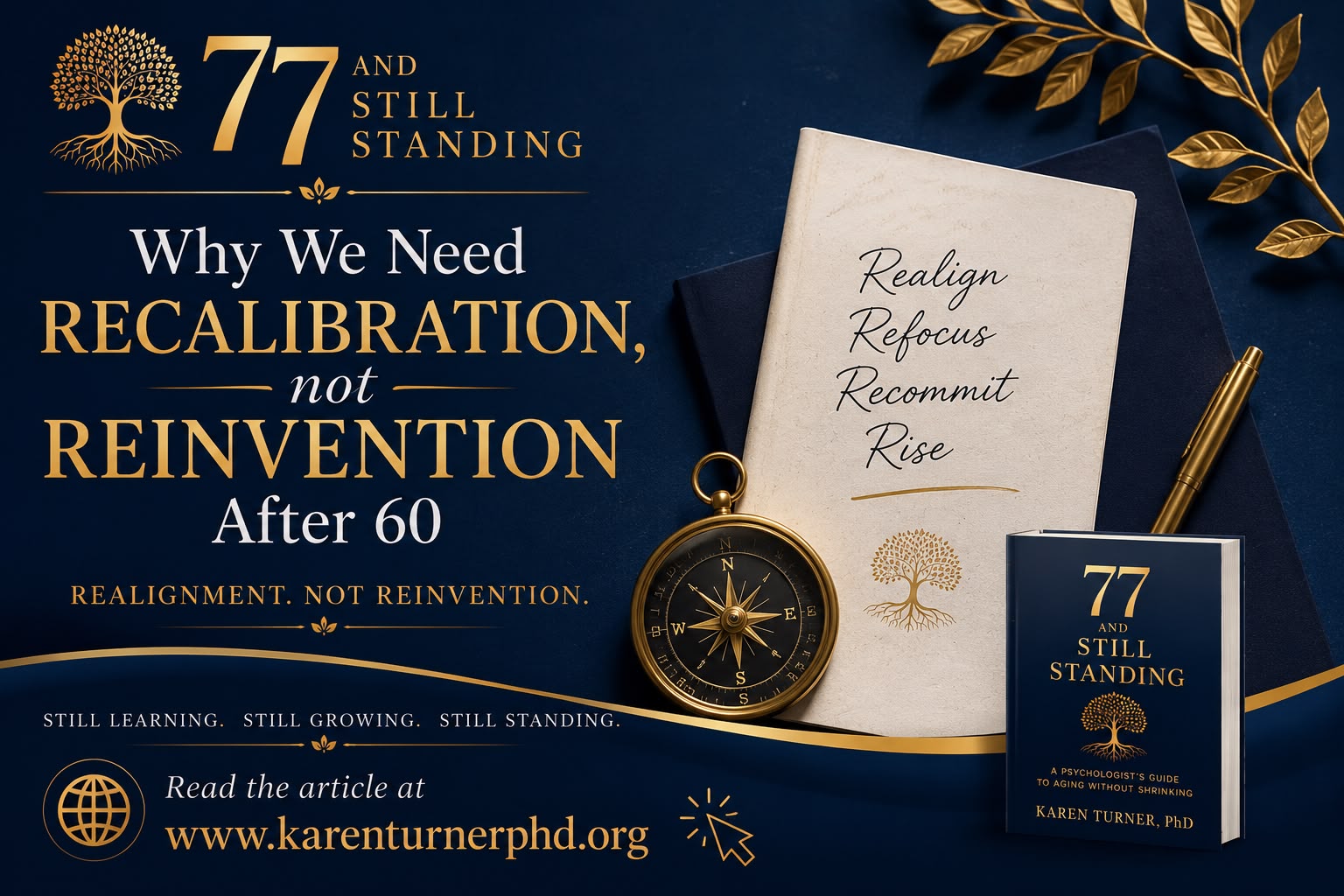
After sixty, the goal isn’t becoming someone new. It’s recalibrating: adjusting your priorities, routines, and mindset to align with the wisdom you’ve already earned, rather than starting over from scratch.
Everywhere we look, we’re told to reinvent ourselves: start over, become someone new, create a completely different life. It’s advice that’s often well-intentioned, but after working as a psychologist for decades, and now living the realities of aging myself, I believe it’s the wrong message for many people over sixty. After sixty, seventy, or eighty, you are not beginning with an empty page. You are beginning with a lifetime of wisdom. You don’t need reinvention. You need recalibration. That simple shift changes everything.
What Does Recalibration Mean After 60?
Recalibration means adjusting your goals, priorities, routines, and mindset to reflect the wisdom you’ve already gained, instead of discarding who you are and starting over. Think about a compass: if it drifts off course, we don’t throw it away. We recalibrate it so it points toward true north again. The same is true for us.
Life changes. Careers end. Children grow up. Health changes. Relationships evolve. Dreams shift. Those changes don’t erase who we are. They invite us to ask a better question: “Given everything I’ve learned, how do I want to live now?” That is recalibration.
Why Reinvention Can Feel So Exhausting
The idea of reinvention suggests that the person you’ve been isn’t enough, that you must become someone entirely different to have a meaningful future. But think about everything you’ve already survived. You’ve adapted through countless seasons. You’ve learned lessons no textbook could teach. You’ve developed resilience, compassion, perspective, patience, and courage. Why would you abandon your greatest assets? Your next chapter shouldn’t ignore your past. It should build upon it.
Your Experience Is Your Superpower
One of the unexpected gifts of aging is perspective. You become less interested in impressing people and more interested in authenticity. You stop chasing perfection and start valuing peace. You recognize that relationships matter more than possessions, and that time, not money, is life’s most precious resource. These are not signs of decline. They are signs of growth, and recalibration allows you to use those insights intentionally.
Five Ways to Begin Recalibrating Today
1. Revisit Your Priorities
Ask yourself: if I were starting today with everything I know now, what would matter most? Your answer may surprise you.
2. Release What No Longer Fits
Some responsibilities, expectations, and even beliefs served an earlier version of your life. You don’t have to carry them forever. Letting go creates room for what matters now.
3. Build on Your Strengths
Instead of focusing on what you’ve lost, ask yourself what you’ve become better at, what wisdom you’ve earned, and how you can use that to help others. Your experience has value.
4. Stay Curious
Curiosity keeps the mind engaged. Read, travel, volunteer, take a class, or learn a new skill. Growth doesn’t stop because birthdays continue.
5. Design, Don’t Drift
Aging happens automatically. Living well does not. Create routines that reflect the life you want. Small, intentional choices repeated consistently create remarkable change.
Recalibration Is About Alignment, Not Loss
One of the greatest misconceptions about aging is that our best years are behind us. I don’t believe that. Different? Absolutely. Meaningful? Without question. Later life often brings something younger years cannot: the freedom to become increasingly authentic, to stop performing, and to stop comparing.
Instead of asking, “What do other people expect?” you begin asking, “What feels true to me?” That is alignment.
The Future Doesn’t Need a New You
The future isn’t asking you to erase your story. It’s asking you to use it. Every success, every disappointment, every mistake, every lesson, every relationship, and every challenge has shaped the person you are today. That person doesn’t need reinvention. That person deserves recalibration.
This is the general shift almost everyone faces at this stage of life, whether or not a specific crisis triggered it. If your own recalibration was brought on by something that nearly broke you, Recalibration, Not Reinvention: Still Standing After the Things That Nearly Broke You speaks directly to that harder version of this same process.
Final Thoughts
77 and Still Standing was never written to convince people that aging is easy. It was written to show that growth remains possible at every stage of life. After sixty, you are not becoming less. You are becoming clearer, more intentional, more authentic, and more fully yourself. Because the goal isn’t to start over. The goal is to find your true north and continue moving toward it.
Frequently Asked Questions
What does recalibration mean after age 60?
Recalibration means adjusting your goals, priorities, routines, and mindset to reflect the wisdom you’ve gained through life. Instead of starting over, you build on your experience.
Why is recalibration better than reinvention?
Recalibration honors your life story. Rather than abandoning who you are, it helps you align your future with your values, strengths, and purpose.
Can you find purpose after retirement?
Absolutely. Many people discover new purpose through volunteering, mentoring, creative pursuits, lifelong learning, family, travel, and community involvement. Retirement often creates space for meaningful contribution in new ways.
Is it too late to change after 60?
No. Research shows that people continue to learn, adapt, develop new skills, and find purpose well into their seventies, eighties, and beyond. Growth has no expiration date.
Related Reading
- Recalibration, Not Reinvention: Still Standing After the Things That Nearly Broke You
- Your Identity Didn’t Retire When Your Career Did
- The Psychology of Successful Aging
- Why Do Some People Seem Younger Than Their Age?
- Why Do I Feel Less Important as I Get Older?
- Can You Become Happier as You Get Older?
- What Does It Really Mean to Age Well?
- 77 and Still Standing