

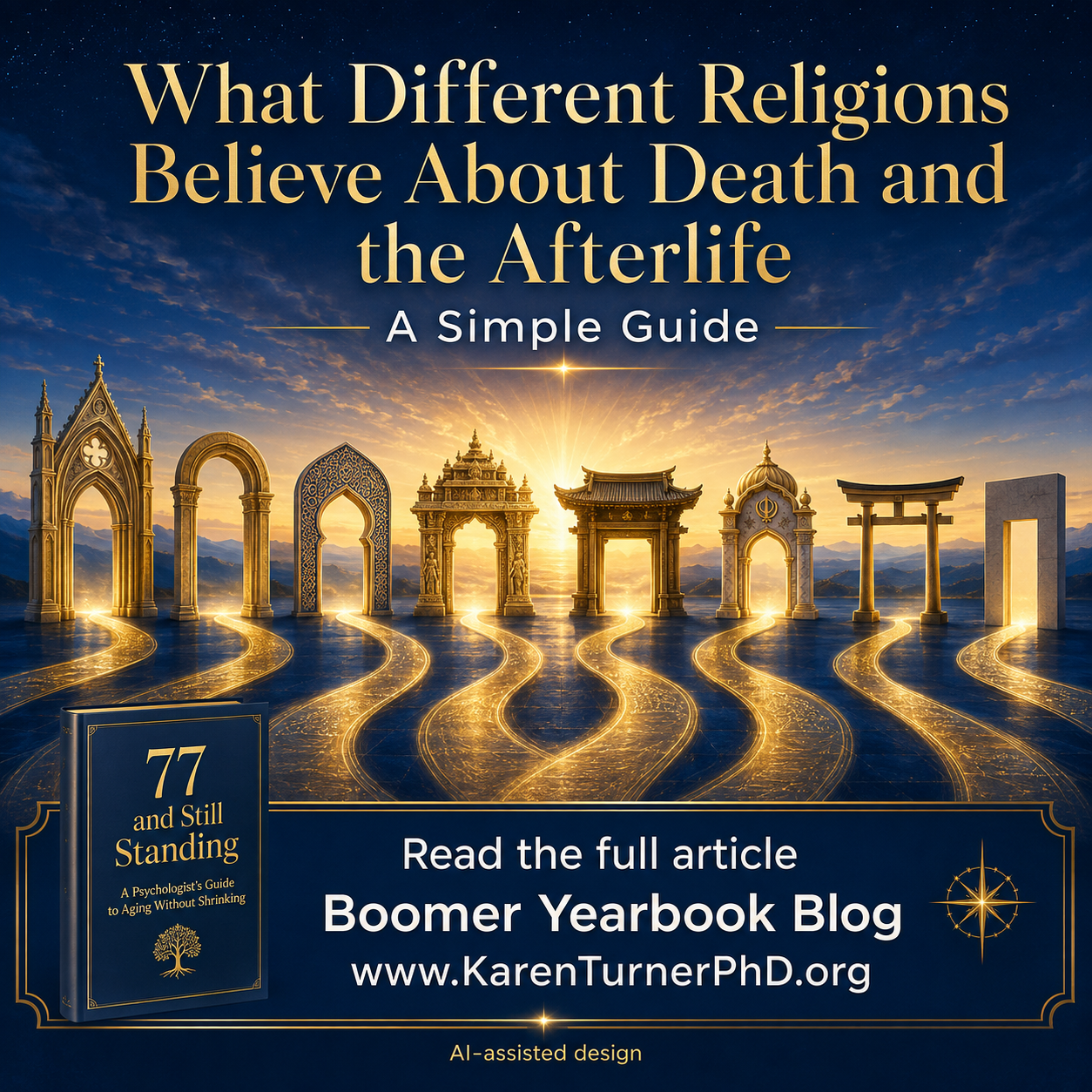
Every religion has tried to answer the question none of us can avoid: What happens when we die?
For some people, death is a passage into eternal life. For others, it is one stage in a continuing cycle of rebirth. Some traditions speak of the soul returning to God, joining the ancestors, or moving toward liberation. A secular or humanist perspective may understand death as the end of individual consciousness while emphasizing the ways a person continues through memory, influence, and love.
These beliefs shape far more than ideas about an afterlife. They influence how quickly a body is buried or cremated, who prepares it, which prayers are offered, how mourning is expressed, and what words feel comforting—or deeply out of place—to a grieving family.
This guide offers a respectful introduction to Christianity, Judaism, Islam, Hinduism, Buddhism, Sikhism, Shinto, and secular humanism. It cannot represent every denomination, school, culture, or family. Individual wishes should always come before assumptions, and when you are uncertain, a gentle question is often the most respectful response.
The goal is not to flatten religious differences into one tidy summary. It is to give you enough context to be considerate, avoid avoidable mistakes, and support a grieving person without making the moment about your own beliefs.
A quick answer: Different religions offer different answers about death and the afterlife. Christianity and Islam generally teach resurrection and judgment. Judaism includes varied teachings about the world to come. Hinduism, Buddhism, and Sikhism describe forms of rebirth or liberation, although they understand the soul differently. Shinto emphasizes continuing bonds with ancestors, while humanism generally centers memory, legacy, and the life that was lived.
Use this guide as a starting point, not a substitute for a family’s own wishes. If you are unsure what matters to the people grieving, begin gently, ask one simple question, and let their answer guide you.
Quick reminder: the most respectful response is often not a perfect explanation. It is a calm presence, careful listening, and a willingness to follow the family’s lead.
Why Religious Beliefs About Death Matter
When a death occurs, people often want to help but are afraid of saying the wrong thing. Learning a little about another person’s tradition is not about mastering theology. It is about understanding what the family may consider sacred, which customs may be time sensitive and how to offer comfort without imposing our own beliefs.
Across traditions, several themes appear repeatedly: respect for the body, community support, remembrance, prayer or reflection, and the search for meaning. The explanations differ, but the human need to honor a life and accompany those who grieve is remarkably consistent.
Christianity
Christian beliefs about death are centered on Jesus Christ’s death and resurrection, but Catholic, Orthodox and Protestant teachings are not identical. Most Christians understand death as a transition rather than the end of the person.
Most Christian traditions teach that the person continues beyond physical death and that the dead will be raised. Heaven, judgment and eternal life are central teachings. Catholicism also teaches purgatory as purification for some souls; many Protestant traditions do not.
The body is treated with dignity because human life is understood as sacred. Burial has been traditional, although cremation is accepted by many Christian denominations today.
A funeral or memorial service commonly includes Scripture, prayer, hymns, a eulogy and words about resurrection and hope. Protestant services vary widely, from formal liturgy to a personalized celebration of life.
Christian grief holds sorrow and hope together. Faith does not eliminate grief, and tears are not a sign of spiritual failure.
You might say:
I am so sorry. I am here with you.
Consider avoiding:
God needed another angel, Everything happens for a reason, or certainty about why God allowed the death. Christians also differ on whether people become angels, so it is better not to make that claim.
Important variation:
Catholic, Orthodox, evangelical, mainline Protestant and other Christian communities may differ significantly in doctrine and ritual.
Judaism
Judaism places strong emphasis on honoring the dead, comforting mourners and living a meaningful life. Jewish teachings about what happens after death are diverse and are often discussed less uniformly than practices for burial and mourning.
Some Jewish traditions speak of Olam Ha-Ba, the world to come, the immortality of the soul or a future resurrection. Other Jews understand these ideas more symbolically or place less emphasis on defining the afterlife.
Traditional practice calls for the body to be treated with great care, ritually washed by a chevra kadisha, dressed in a simple shroud and buried promptly in a plain casket. Traditional Judaism prefers burial; approaches to cremation vary.
The funeral is followed by structured periods of mourning. Shiva traditionally marks the first seven days, and the Mourner’s Kaddish, yahrzeit anniversaries, memorial candles and Yizkor services help carry remembrance forward.
Judaism gives grief a communal structure. Visitors are not expected to fix the loss; their presence and practical help can be more important than an explanation.
You might say:
May their memory be a blessing.
Consider avoiding:
Theological assurances the family has not expressed, pressure to speak, or phrases beginning with at least. At a shiva home, allow the mourners to guide the conversation.
Important variation:
Orthodox, Conservative, Reform, Reconstructionist, secular and culturally Jewish families may observe different practices.
Islam
In Islam, earthly life is temporary and death is a return to Allah. Belief in the hereafter is central, and funeral practices emphasize dignity, equality, prayer and prompt burial.
Muslims generally believe that the soul continues after death, enters an intermediate state often called barzakh, and awaits resurrection and judgment. Paradise is called Jannah; hell is Jahannam.
The body is usually washed in a ritual known as ghusl, wrapped in a simple white shroud called a kafan and buried as soon as reasonably possible. Cremation is ordinarily prohibited.
Family and community gather for prayer, burial, recitation of the Qur’an and practical support. Charity and prayer may be offered in the person’s memory.
Grief is recognized as natural. Patience, or sabr, and trust in Allah may bring comfort.
You might say:
I am very sorry for your loss.
Consider avoiding:
Speculating about judgment, saying the death was deserved or using they are in a better place unless the family has used that language first. Do not bring food containing pork or alcohol.
Important variation:
Local customs and Sunni, Shia and other Muslim traditions may shape the timing and details of mourning.
Hinduism
Hinduism includes many philosophies and regional traditions, but death is commonly understood within the larger movement of karma, rebirth and liberation.
Many Hindus believe the atman, the enduring spiritual self, is not destroyed when the body dies. It continues through samsara, the cycle of birth, death and rebirth, shaped by karma. The highest spiritual goal is moksha.
Cremation is common because the physical body is temporary and the soul must continue its journey. Ashes may later be placed in flowing water.
Rites vary by region and family. They may include prayers at the bedside, cremation, offerings, a mourning period and later shraddha remembrance ceremonies honoring the deceased and ancestors.
Grief is natural, but rituals can help the family gradually release the physical presence of the person while continuing bonds of duty, love and remembrance.
You might say:
I am so sorry for your loss. I am thinking of your family.
Consider avoiding:
Guessing what the person’s next life will be, suggesting that the death was caused by bad karma, or assuming every Hindu family follows the same rituals.
Important variation:
Hindu beliefs and funeral customs differ widely by philosophy, region, caste, language, migration history and family preference.
Buddhism
Buddhism teaches impermanence, karma and freedom from suffering, but Theravada, Mahayana, Zen, Pure Land and Tibetan Buddhist traditions may describe death and what follows in different ways.
Many Buddhist traditions teach rebirth shaped by karma, with nirvana as freedom from the cycle of suffering and rebirth. Buddhism generally does not teach an eternal, unchanging soul in the same sense as many other religions.
The body may be left undisturbed for a period in some schools. Chanting, meditation or recitation may occur nearby. Cremation is common, although burial and other practices vary by country and Buddhist tradition.
Monks, priests, teachers or family members may chant sutras, meditate, offer incense, transfer merit or hold memorial services on designated days.
Impermanence is not used to deny grief. Buddhist practice may invite mourners to meet sorrow with compassion, mindfulness and awareness that love and loss are inseparable parts of human life.
You might say:
May they be at peace.
Consider avoiding:
You need to detach, Their karma caused this, or assuming that every Buddhist believes in the same kind of reincarnation.
Important variation:
Beliefs about consciousness after death, rebirth, memorial timing and treatment of the body differ markedly among Buddhist schools.
Sikhism
Sikhism understands life and death within Hukam, the divine order, and teaches that spiritual life is directed toward union with Waheguru, God.
The soul is not understood to end with physical death. Sikh teaching describes a cycle of birth and death, with liberation found in union with Waheguru.
The body is generally bathed and dressed in clean clothing. Cremation is preferred, although other respectful forms of disposition may be used when cremation is not possible.
Gurbani may be recited and Waheguru repeated near the dying person and after death. The funeral, Antam Sanskar, may include hymns, Kirtan Sohila and Ardas.
Sikh tradition encourages calm acceptance of Hukam and discourages excessive ritualized lamentation. Community, prayer and langar, the shared meal, can provide strength.
You might say:
I am so sorry. May Waheguru give you and your family strength.
Consider avoiding:
Telling mourners they should not cry, treating death as a cause for celebration without acknowledging loss, or removing or questioning the Five Ks.
Important variation:
Sikh families may combine religious guidance with Punjabi, regional or local customs.
Shinto and Japanese Traditions
Shinto does not have one universally defined doctrine of the afterlife. It is deeply connected to life, place, purification, kami and continuing relationships with family ancestors.
Formal Shinto funeral traditions may understand the deceased person’s spirit as remaining close to the household and eventually joining the family’s ancestors. Shinto mythology also contains images of Yomi, a realm associated with death.
In a Shinto funeral, or shinsosai, the spirit may be ritually transferred to a spirit vessel and later enshrined with the ancestors. Purification rites may follow because death is associated with kegare, a ritual disruption.
A Shinto priest may offer prayers and a sacred evergreen branch, or tamagushi. Food offerings, home remembrance and memorial observances may honor the continuing presence of the deceased.
Grief may be held through remembrance, family duty, offerings, visits and the sense that ancestors remain part of the household’s moral and spiritual life.
You might say:
I am deeply sorry for your loss.
Consider avoiding:
Assuming every Japanese person is Shinto, calling ritual impurity sin, or mixing Shinto and Buddhist symbols without knowing what the family actually practices.
Important variation:
Japanese religious identity is often nonexclusive. A family may use Shinto rites for some life events and Buddhist rites for funerals, or may practice neither formally.
Secular and Humanist Perspectives
Secular and humanist perspectives do not depend on a supernatural explanation of death. They place meaning in the life that was lived, human relationships, shared values and the legacy a person leaves.
Many humanists understand death as the end of individual consciousness and do not believe in a soul that survives bodily death. A person may nevertheless be understood to continue through memories, influence, love, work, family stories and the changes they made in other people’s lives.
There is no required humanist method. Burial, cremation, green burial, donation to science and other lawful choices may all be meaningful, depending on the person’s wishes.
A humanist funeral or celebration of life is often led by a celebrant and centered on the person’s story. Music, readings, silence, humor, photographs and shared memories may replace prayer while still creating dignity and ritual.
Grief is treated as a natural human response to attachment and loss. Comfort may come from community, memory, honest acknowledgment of death and gratitude for the life that was shared.
You might say:
I am so sorry. I will always remember the way they…
Consider avoiding:
Religious assurances such as they are with God now unless the family has welcomed that language, or suggesting that a nonreligious ceremony is less meaningful or sacred.
Important variation:
Secular, atheist, agnostic and humanist are not interchangeable labels, and people may combine nonreligious beliefs with cultural traditions.
What These Traditions Share
- The body should be treated with dignity.
- The person who died should be remembered rather than reduced to the manner of death.
- Grieving people need community, patience and practical care.
- Ritual gives form to an experience that can otherwise feel impossible to understand.
- Love continues to shape the living, whether it is described as prayer, memory, ancestorhood, spiritual connection or legacy.
The Safest Thing to Say When You Are Unsure
You do not need perfect religious knowledge to be compassionate. Start with the loss, not an explanation: I am so sorry. I care about you, and I am here.
Then listen. If practical help would be useful, make the offer specific: May I bring dinner on Tuesday? Would you like a ride to the service? or Would it help if I called next week?
If you want to acknowledge the family’s tradition, it is acceptable to ask: Is there a customary way I can honor them or support your family? That question communicates respect without pretending to know what this particular person believes.
A Final Thought
Death remains a mystery even inside traditions that speak about it with confidence. No comparison can settle what lies beyond life, and no doctrine can make grief painless.
But across religions and worldviews, people have created ways to care for the body, gather the community, remember the person and help the living take the next step. Our beliefs about death may differ, but nearly every tradition reminds us that how we live, love, remember and care for one another matters.
Frequently Asked Questions
What do different religions believe happens after death?
Christianity and Islam generally teach continued personal existence, resurrection and judgment. Judaism includes varied teachings about the soul and the world to come. Hinduism, Buddhism and Sikhism teach forms of rebirth or liberation, although they define the self or soul differently. Shinto often emphasizes ancestors and continuing household bonds. Humanism generally focuses on memory, influence and the life that was lived rather than a supernatural afterlife.
Which religions believe in reincarnation or rebirth?
Hinduism and Sikhism teach a cycle of birth and death connected with karma and liberation. Many Buddhist traditions teach rebirth, but generally not the migration of an eternal, unchanging soul. Beliefs and explanations vary within all three traditions.
Which religions prefer burial after death?
Judaism and Islam traditionally emphasize prompt burial. Christianity has a long tradition of burial, although cremation is accepted in many denominations. Individual practice may also be affected by local law, family wishes and cultural custom.
Which religions commonly practice cremation?
Cremation is common in Hinduism, Buddhism and Sikhism. It is also widely practiced in contemporary Japan, where funerals are often Buddhist or combine several traditions. Many Christian denominations permit cremation, while Judaism and Islam have traditionally preferred or required burial.
What is the most respectful thing to say to a grieving person of another faith?
Begin without making a theological claim: I am so sorry. I care about you, and I am here. Follow the family’s language, listen more than you explain and ask whether there is a customary way to honor the person or support the family.
Why is it important not to generalize about religious funeral customs?
Every major religion contains denominations, schools, regional customs and individual interpretations. Families may also combine religious and cultural practices. The safest approach is to learn broad principles while asking what this particular family wants.
Is Shinto the religion used for most Japanese funerals?
Not necessarily. Shinto has its own funeral rites, but many Japanese funerals are Buddhist, and families may combine Shinto, Buddhist and ancestor-remembrance customs. Japanese identity and practice are often not limited to one exclusive tradition.
Educational note: This article provides general educational guidance, not individualized religious, pastoral, or funeral advice. If you are unsure about a family’s wishes, ask a trusted family member, clergy person or celebrant.
Reviewed: 2026-08-27
Related Reading
- What Does It Really Mean to Age Well?
- A Living Will: Long Term Health Insurance
- What to Do Financially When Your Spouse Dies
- When Helping Your Adult Children Begins to Hurt You
- How to Reconnect With an Estranged Adult Child
Sources
- U.S. Conference of Catholic Bishops — Catechism: Resurrection and Life Everlasting
- Union for Reform Judaism — What to Expect at a Jewish Funeral
- Union for Reform Judaism — Jewish Expressions After a Death
- Islamic Relief UK — When Someone Dies in Islam
- Islamic Relief Worldwide — Dignified Muslim Burial Practices
- Hindu American Foundation — Five Things to Know About Hindus and Death
- Tricycle: The Buddhist Review — Buddhist Death Rites
- Buddhist Churches of America — Grief, Impermanence and Interdependence
- Sikh Rehat Maryada — Funeral Ceremonies
- Kokugakuin University Encyclopedia of Shinto — Shinsosai
- Humanists UK — Non-Religious Funeral and Memorial Ceremonies