

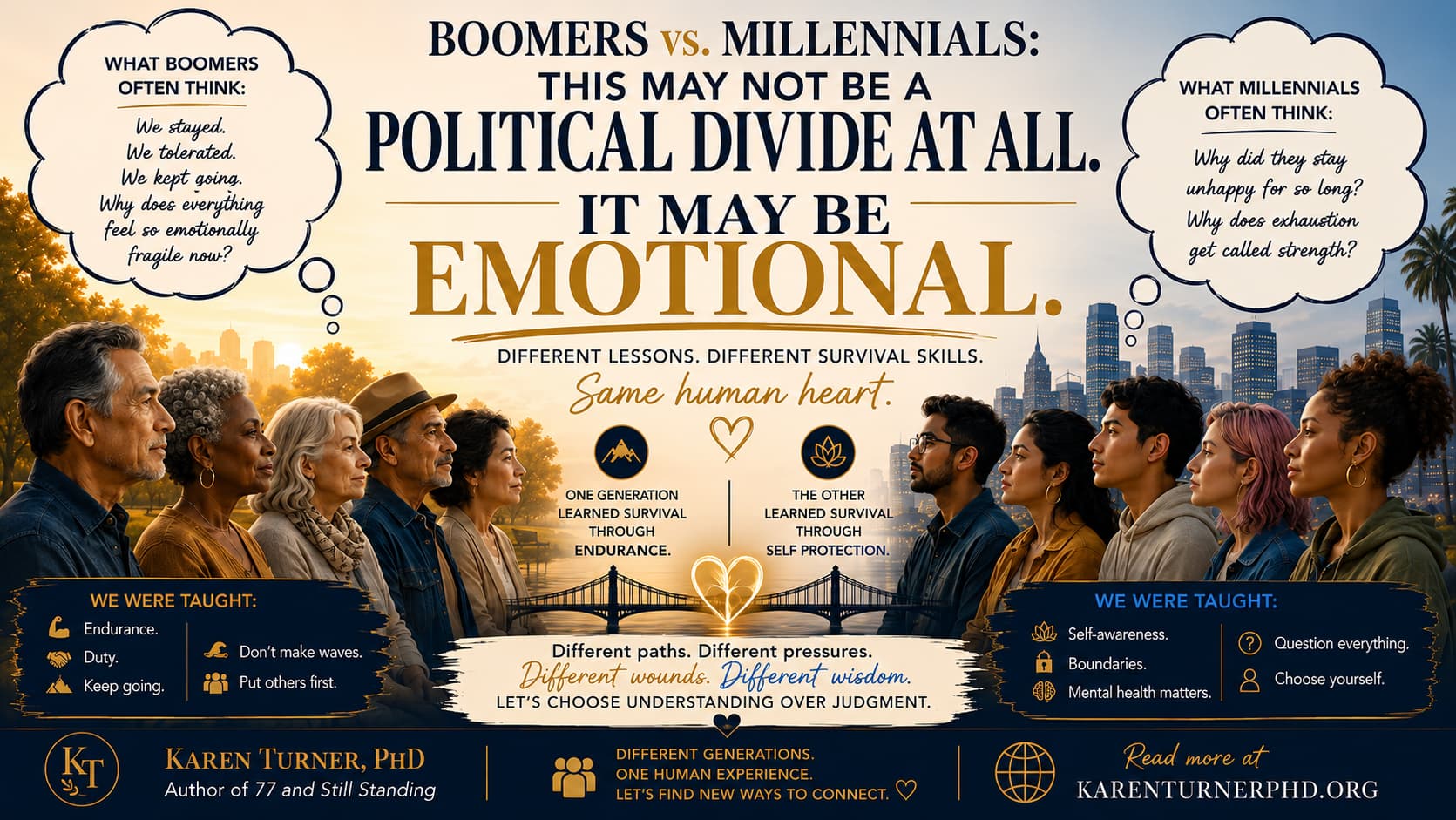
The growing divide between boomers and millennials is often framed as political, but it usually runs deeper: two generations were simply raised with entirely different emotional survival systems. Families are no longer arguing only about politics. Increasingly, they are struggling to understand each other emotionally. Parents and adult children stop speaking, siblings avoid holidays, and conversations become tense before they even begin.
Is the Boomer vs. Millennial Divide Really About Politics?
On the surface, it appears political. Baby boomers and millennials often seem to hold very different views about work, relationships, capitalism, emotional boundaries, social responsibility, identity, and even what constitutes a meaningful life. But perhaps this divide is not entirely political at all. Perhaps it is emotional, and perhaps these generations were simply raised with entirely different emotional survival systems.
How Were Boomers Taught to Cope Emotionally?
Many baby boomers were raised to endure. You stayed, you tolerated, you kept going. Emotional restraint was often considered maturity, self-sacrifice was admired, and duty came before self-expression. For many boomers, strength meant functioning despite disappointment, loneliness, exhaustion, or emotional unhappiness: you worked, you provided, you stayed married, you handled things privately, and you did not center your emotional needs. While that created extraordinary resilience in many people, it also created generations of adults who often ignored their own emotional wellbeing for decades. Many boomers now find themselves emotionally exhausted after lifetimes of caregiving, people-pleasing, and playing the strong one in order to keep families stable.
How Were Millennials Taught to Cope Emotionally?
Millennials were often raised differently. They grew up during an era that emphasized emotional awareness, boundaries, therapy, mental health language, self-care, and questioning unhealthy systems. For many millennials, emotional suffering is not automatically viewed as noble. It is viewed as something to examine. That difference alone changes almost everything.
Why Do the Two Generations Misread Each Other?
To some boomers, millennials can appear fragile, overly sensitive, or too quick to walk away from discomfort. But to many millennials, boomers appear emotionally disconnected from themselves, overly tolerant of unhappiness, and conditioned to accept emotional depletion as normal life. Each generation is often misreading the coping style of the other. Boomers may quietly think, “We survived difficult things without constantly talking about them.” Millennials may quietly think, “Why would anyone stay emotionally unhappy for so long?” Underneath these reactions is something much deeper than politics: fear, stress, pressure, emotional exhaustion, and the universal desire to feel emotionally safe in an increasingly unstable world.
What Can Each Generation Learn From the Other?
Perhaps that is why political disagreements now feel so emotionally loaded. People are not simply defending ideas anymore. They are defending entire emotional survival systems: one generation learned survival through endurance, the other learned survival through self-protection. Both approaches contain wisdom, and both approaches contain blind spots. Endurance without emotional awareness can become self-abandonment. Emotional awareness without resilience can become fragility. Perhaps what both generations truly need from each other is not judgment, but integration:
- Boomers may have something important to teach about perseverance, loyalty, responsibility, and continuing through uncertainty.
- Millennials may have something important to teach about emotional honesty, boundaries, mental health, and recognizing when survival itself has become emotionally damaging.
The Takeaway
Perhaps the healthiest future lies somewhere in the middle: not between capitalism and socialism, not between conservative and liberal, not between old and young, but between two generations slowly beginning to understand that they were simply taught very different ways to survive emotionally. That understanding matters now more than ever, and it starts with the same emotional honesty both generations are still learning to offer each other.
Related Reading
- What Baby Boomers Wish Their Children Understood
- Adult Children Pull Away From Aging Parents (And What You Can Do About It)
- When Expectations Hurt: Letting Go of the Family Story You Thought Would Happen
- What Aging Parents Wish Their Adult Children Knew (But Rarely Say)
- The Loneliness of Being the Strong One