
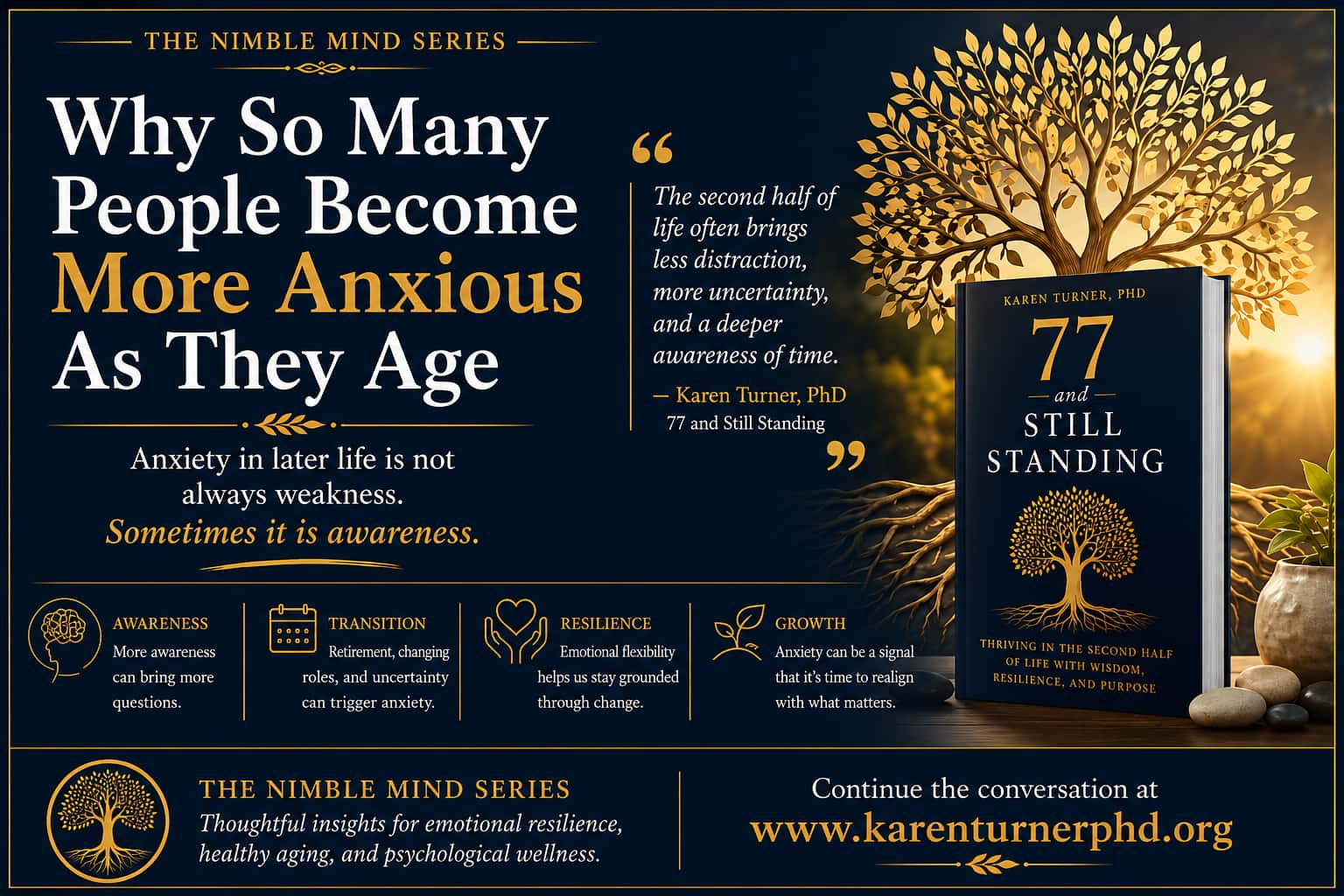
Anxiety often increases with age not because life gets harder, but because awareness gets deeper. There comes a point in later life when anxiety becomes less about daily stress and more about a heightened awareness of time, uncertainty, vulnerability, and the sense that life is becoming both more precious and more finite at once.
Why Doesn’t Aging Feel Calmer Than Expected?
Many people are surprised by this. Aren’t the later years supposed to feel calmer, simpler, less stressful? But psychologically, aging often brings a very different emotional landscape than people expect, because growing older does not only bring wisdom. It also brings awareness. For decades, many adults stay psychologically occupied by constant activity: careers, parenting, responsibilities, schedules, caretaking, deadlines, survival. There is little time to sit still long enough to fully absorb deeper emotional realities. But later in life, the distractions begin falling away, and in that more reflective space, people often become newly aware of questions they once pushed aside.
- Who am I now?
- What still matters to me?
- How much time do I have left?
- What happens if my health changes?
- Who will still be here?
- What happens when roles and identities begin shifting?
These are deeply human questions, but they can also create anxiety, especially when people feel emotionally unprepared for this stage of life.
Does Retirement Itself Cause Anxiety?
It often plays a role. Many people imagine retirement will feel entirely freeing, and for some it does. But for others, retirement removes important structures that once provided identity, purpose, predictability, and social connection. Without those structures, underlying anxiety sometimes becomes more noticeable. There is also the psychological reality that uncertainty tends to increase with age: health concerns become more real, loss becomes more frequent, adult children build lives of their own, social circles sometimes narrow, and the future can begin feeling less predictable. The human mind does not particularly enjoy uncertainty. In many ways, anxiety is often the mind’s attempt to create a sense of control in situations where complete control no longer exists.
Is Increased Anxiety a Sign of Decline?
Not necessarily. That does not mean anxiety should simply be ignored, but it does mean it should be understood with compassion rather than shame. Many highly capable, emotionally strong, intelligent people experience increased anxiety later in life, often privately, and sometimes while appearing completely fine from the outside. If that sounds familiar, you may recognize it in Why Smart People Worry More as They Age, a closer look at how intelligence and overthinking intersect with age.
As people age, they often become more emotionally honest with themselves. The coping mechanisms that once kept uncomfortable feelings buried may no longer work as effectively, and some people become less willing or less able to distract themselves endlessly. Emotional honesty can ultimately lead to tremendous growth, but it can initially increase emotional discomfort, especially anxiety. Anxiety in later life is not always a sign of decline. Sometimes it is a sign that the mind is attempting to recalibrate, to reevaluate priorities, confront reality more directly, seek meaning more honestly, and let go of illusions that no longer fit. That process can feel emotionally disorienting before it begins feeling clarifying.
What Does Emotional Resilience Actually Look Like Later in Life?
Anxiety does not always need to disappear completely in order for people to live meaningful, emotionally rich lives. The goal is not emotional perfection. The goal is resilience: the ability to remain engaged with life despite uncertainty, and to continue finding moments of connection, curiosity, beauty, meaning, and purpose even while recognizing that life contains vulnerability. That is emotional maturity.
Perhaps one of the most reassuring truths about aging is this: many people eventually become less interested in controlling everything and more interested in experiencing life honestly. Less performance, more authenticity. Less proving, more presence. That shift can bring enormous psychological relief. Healthy aging is not about becoming fearless. It is about becoming more emotionally flexible, more self-aware, more grounded, and more compassionate toward yourself and others. Sometimes anxiety itself becomes part of that awakening, not because it is pleasant, but because it asks us to pay attention to what matters most.