

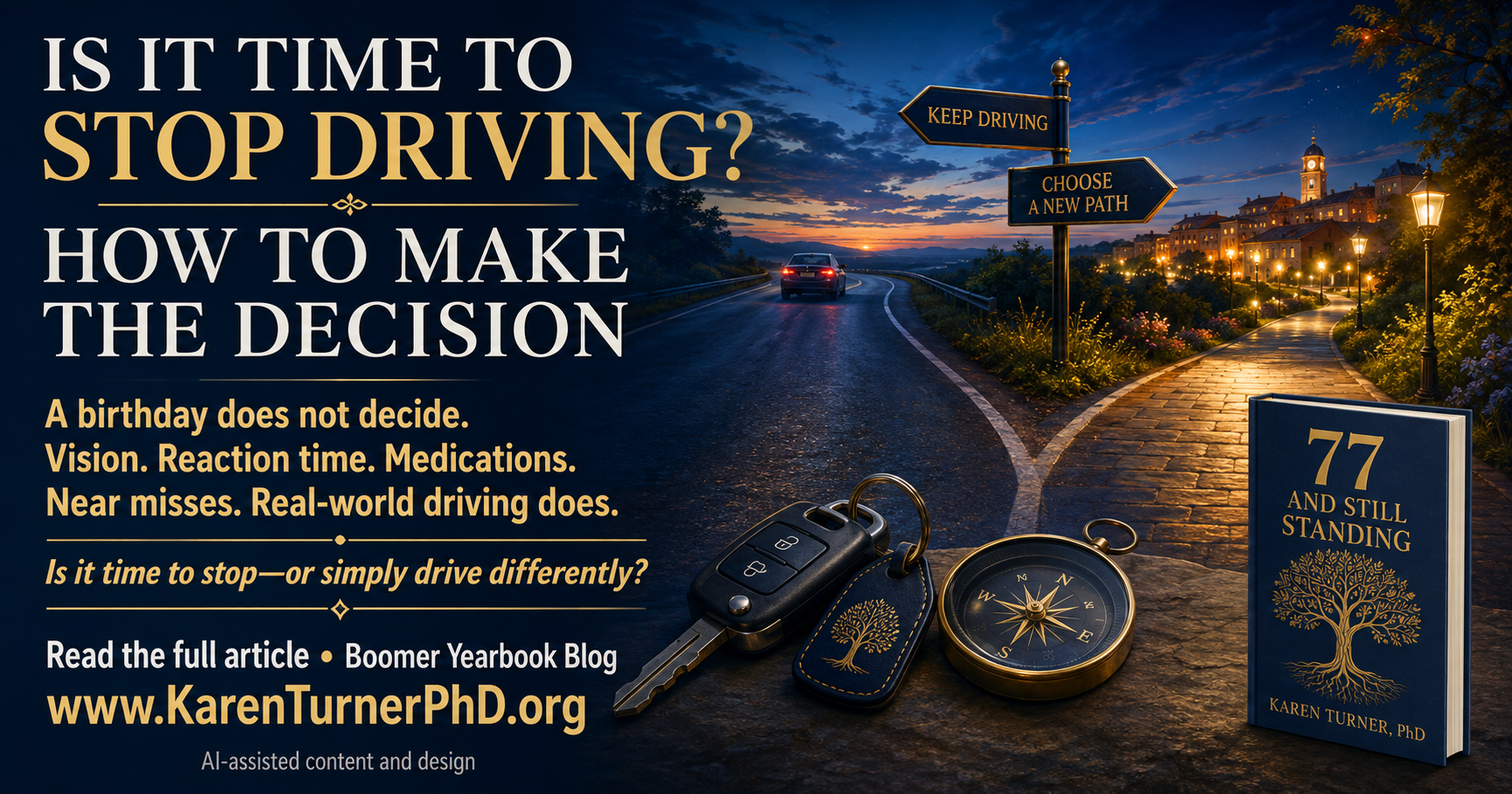
How to Make the Decision
By Karen Turner, PhD · Published 2026-08-28 · Last updated 2026-08-28
For many older adults, driving is not simply transportation. It represents freedom, competence, privacy, and adulthood. It is how people buy groceries, see friends, keep appointments, and leave home without asking permission.
That is why a conversation about driving can feel like a conversation about identity. Families sometimes wait too long or push too hard. One side sees danger; the other hears, “You are no longer capable.”
When should an older adult stop driving? There is no single age. The decision should be based on current driving ability, vision, thinking, physical function, medication effects, crashes or near misses, and an on-road evaluation when needed. Warning signs include getting lost on familiar routes, unexplained dents, pedal confusion, delayed reactions, and concern from multiple passengers.
Start with evidence, not age
Driving requires clear vision, attention, judgment, memory, coordination, reaction time, strength, flexibility, and a response to the unexpected. Age alone does not measure these abilities. A diagnosis alone may not settle the question either. What matters is how a condition, medication, or functional change affects real driving.
One mistake does not automatically mean a person must stop. Patterns matter, especially when the driver does not recognize them. The National Institute on Aging notes that health changes, injuries, and medication side effects can affect driving skills, and that there is no one recommended age to quit.
Warning signs that deserve attention
| What you notice | A reasonable next step |
|---|---|
| Getting lost on familiar roads, missing signs, or lane drift | Arrange medical review and consider a professional driving evaluation. |
| New dents, scrapes, near misses, tickets, or collisions | Record specific observations and discuss the pattern calmly. |
| Pedal confusion, delayed reactions, or failure to notice hazards | Stop driving until qualified assessment gives clear guidance. |
| Difficulty with glare, dusk, night, or reading signs | Schedule an eye examination and avoid unsafe conditions meanwhile. |
| Drowsiness, dizziness, confusion, or medication changes | Ask a prescriber or pharmacist to review the full medication list. |
| Passengers repeatedly feel unsafe | Listen to the concern and seek an objective evaluation. |
Vision, hearing, strength, flexibility, sensation, sleep, and medical conditions can all matter. Glare sensitivity, cataracts, glaucoma, macular degeneration, outdated glasses, arthritis, neuropathy, limited neck movement, sleep apnea, stroke, Parkinson’s disease, and medication effects need individualized review. Do not stop prescribed medicines on your own.
A fair driving decision process
- Write down concerns. Use observations and dates: “There were two near misses while turning left this month,” rather than “Dad is a terrible driver.”
- Review vision, health, and medicines. Ask a doctor, eye-care professional, and pharmacist whether anything could affect driving.
- Use a self-assessment. Self-awareness can help, but it may not be enough when insight has changed.
- Seek an on-road evaluation when needed. A driver rehabilitation specialist, often an occupational therapist with additional training, can assess function and actual driving performance.
- Choose a path. Continue with monitoring, drive with evidence-based limits, or stop and activate a transportation plan.
An objective evaluation can reduce family conflict because the decision is not based only on one relative’s opinion. Licensing and reporting rules vary by location, so check the appropriate motor vehicle agency.
When driving differently may be enough
Some drivers can reduce risk by driving only in daylight and good weather, using familiar lower-speed routes, avoiding rush hour, highways, difficult left turns, and distractions, allowing more following distance, and using current glasses or hearing devices. Clean mirrors and headlights, a car with useful safety features, or professionally recommended adaptations can also help.
Restrictions must reflect a genuine assessment. They should not be used indefinitely to hide serious or progressive impairment. Repeated pedal confusion, getting lost on familiar routes, failure to notice hazards, multiple collisions, significant cognitive impairment, or a professional recommendation not to drive make stopping more urgent.
How to talk without starting a war
Choose a calm time, not immediately after a frightening ride. Whenever possible, let the older adult lead the process. Say: “I know driving is central to your independence. I want to protect that independence and everyone’s safety. Could we look at the specific concerns together and get an objective evaluation?”
Avoid “You are too old to drive.” Use observations rather than verdicts. If several relatives are worried, one trusted person should begin the conversation. A group confrontation can feel like an ambush. NIA recommends focusing on skills rather than age and offering help to preserve independence.
Build the transportation plan before the crisis
Driving retirement is easier when alternatives are real. Map medical appointments, groceries, pharmacy visits, worship, clubs, volunteering, family visits, exercise, and spontaneous trips. Then identify family and friends, public transit, paratransit, senior transportation, taxis, ride services, volunteer drivers, grocery delivery, pharmacy delivery, and community shuttles.
Practice before driving stops. Take the bus together. Set up a ride service. Calculate the full cost of owning a car, including insurance, fuel, repairs, registration, parking, and depreciation. The loss may be privacy, usefulness, or spontaneity, not only transportation. A safe transition protects mobility, choice, connection, and dignity. The car is one form of independence, not the only one.
Frequently Asked Questions
Is there a certain age when older adults should stop driving?
No. Driving ability should be judged by vision, cognition, physical function, medication effects, driving history, and real-world performance, not age alone.
What are the clearest signs it may be time to stop driving?
Serious signs include getting lost on familiar roads, pedal confusion, repeated near misses or collisions, unexplained vehicle damage, missing obvious hazards, and recommendations from qualified professionals.
Who can evaluate an older adult’s driving?
A doctor, eye-care professional, and pharmacist can assess health-related risks. A driver rehabilitation specialist can provide a comprehensive evaluation that may include on-road performance.
Can an older adult drive safely with restrictions?
Sometimes. Daylight-only driving, familiar routes, good weather, and adaptive equipment may reduce risk for some people. Restrictions should be based on actual ability and reviewed as conditions change.
How do I talk to a parent who refuses to stop driving?
Use specific observations, acknowledge what driving represents, suggest an objective evaluation, and offer a detailed transportation plan. Avoid saying the person is simply too old.
Do driving laws for older adults vary by state?
Yes. License renewal, vision testing, medical review, and reporting rules vary. Check the current requirements of the driver’s state motor vehicle agency.
Sources and further reading
- National Institute on Aging: Safe Driving for Older Adults
- NHTSA: Driving Safely While Aging Gracefully
- NHTSA: How to Understand and Influence Older Drivers
This article provides general educational information. Driving fitness, licensing requirements, and reporting rules vary; consult qualified professionals and the appropriate motor vehicle agency.