

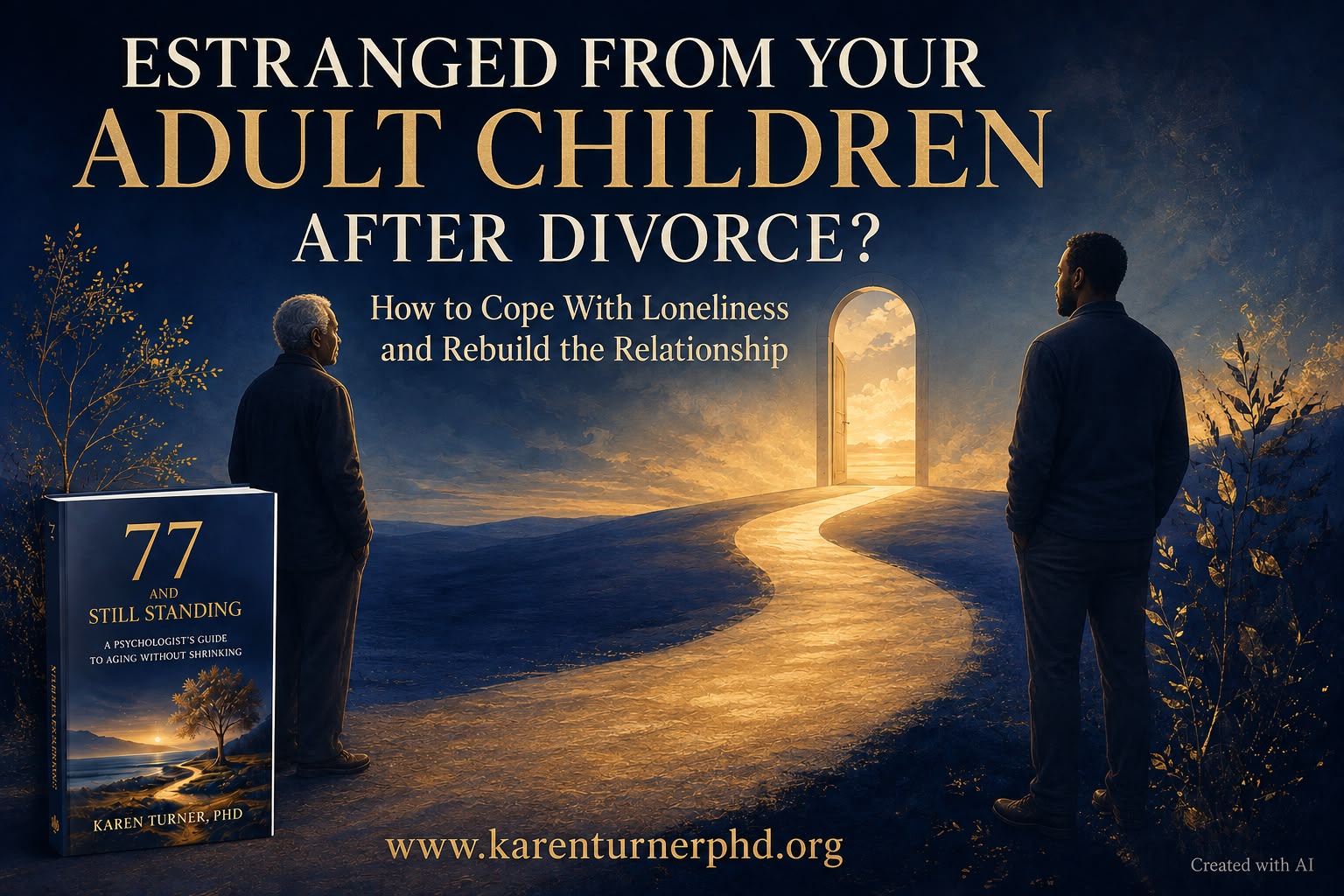
Divorce can fracture more than a marriage. Here is how older parents can cope with the grief of family estrangement, reach out without pushing, and create a meaningful life while leaving the door open to reconciliation.
Divorce ends a marriage, but sometimes its effects spread through an entire family.
An adult child may take sides. Old grievances may return with new force. One parent may become the keeper of the family gatherings, holidays, grandchildren, and shared history, while the other is slowly pushed to the edge. Months can pass without a telephone call. Birthdays are missed. Photographs of family celebrations appear online, and you realize that everyone was invited except you.
For an older parent, this is more than a disagreement. It can feel like the loss of an identity, a family, and an imagined future all at once.
Yet estrangement does not always mean the relationship is permanently over. Reconciliation may be possible, although it cannot be demanded or guaranteed. The first task is to understand what happened, approach your adult child differently, and protect your own emotional life while the outcome remains uncertain.
Why Do Adult Children Become Estranged After Their Parents Divorce?
There is rarely one simple explanation. Even adult children can feel destabilized by their parents’ divorce. They may believe that the family history they trusted was not what it seemed. They may identify more strongly with one parent, feel responsible for protecting that parent, or carry anger about events that occurred years earlier. Estrangement may also grow from:
- Feeling pressured to choose sides.
- Hearing repeated criticism of the other parent.
- Unresolved childhood hurts that surface during the divorce.
- Disagreements about money, inheritance, caregiving, or family loyalty.
- A new spouse or partner changing the family dynamic.
- Different memories of what happened within the marriage.
- An adult child’s wish to establish stronger boundaries.
You may believe your former spouse influenced your child’s decision. That may be partly true. But making the former spouse the entire explanation can prevent you from hearing what your child is trying to communicate. The most useful question is not only, “Who caused this?” It is also, “What might help us communicate differently now?”
Why Is Estrangement Especially Lonely Later in Life?
Family estrangement can hurt at any age, but it carries particular weight in the later years. Retirement may have reduced daily contact with colleagues. Friends may have moved, become ill, or died. A former spouse may already be gone from your life. Adult children and grandchildren may have represented continuity, belonging, and the people with whom you expected to share holidays and milestones.
A 2025 study of parents aged 75 and older, published in the Journal of Social and Personal Relationships, compared estranged and non-estranged parents and found that estrangement from an adult child was associated with significantly poorer scores on all four measures examined: well-being, sense of purpose, depressive symptoms, and loneliness. (Nikolajsen, Larsen, Christoffersen, Holstein, and Swane, Estrangement between older parents and adult children: Associations with mental health.)
There is also a form of grief that accompanies estrangement. The person is still alive, but the relationship is unavailable. There may be no ceremony, condolences, or accepted way to mourn. Shame can make the isolation worse, because many parents are afraid to tell friends what has happened.
But your child’s absence is not proof that your life has no value, and estrangement is not a final judgment on your entire history as a parent.
Should You Contact an Estranged Adult Child?
In many situations, one respectful attempt at contact is appropriate. The goal is not to settle every disputed fact. It is to make future communication safer. Before reaching out, ask yourself:
- Can I listen without immediately defending myself?
- Can I acknowledge my child’s experience even if I remember events differently?
- Can I tolerate no response, or a response that hurts?
- Am I offering connection, or demanding relief from my loneliness?
If your child has specifically requested no contact, respect that boundary. Unless there is an emergency or a professional advises otherwise, repeated messages, surprise visits, contacting grandchildren directly, or recruiting relatives to intervene can deepen the estrangement.
Safety matters as well. Reconnection may not be appropriate when there has been abuse, intimidation, exploitation, or a serious threat to anyone’s well-being.
What Should You Say in Your First Message?
Keep the first message brief, warm, and free of accusation. Do not use it to present your entire case. You might write:
I have been thinking about you and about the distance between us. I realize that there may be things I have not fully understood about your experience. I would be willing to listen without arguing or asking you to take sides. I love you, and if you are ever open to a conversation, the door is open. I will respect the space you need.
This message does not surrender your dignity. It communicates love, accountability, and respect without applying pressure. Avoid statements such as:
- “After everything I have done for you…”
- “Your mother or father turned you against me.”
- “You will regret this when I am gone.”
- “I deserve to see my grandchildren.”
- “Tell me what I did, because I have no idea.”
Those sentences may express genuine pain, but they place the emotional burden on the child and can sound like blame, guilt, or a demand for immediate repair.
Should You Apologize if You Do Not Believe Everything Was Your Fault?
Yes. You can apologize for your part without accepting responsibility for everything that occurred. A useful apology is specific. It does not contain the word “but,” and it does not require forgiveness in return. For example:
I am sorry I spoke critically about your father during the divorce and put you in the middle. I was hurt and angry, but it was not fair to ask you to carry those feelings.
That is very different from:
I am sorry you feel that way, but you do not know what I went through.
The second statement defends the parent. The first recognizes the child’s experience. Listening and validating do not mean agreeing with every interpretation. They mean demonstrating that your child’s feelings can exist without being corrected, dismissed, or treated as betrayal. Guidance on reconnecting with an estranged adult child consistently emphasizes the same three things: lower emotional reactivity, empathy, and validation.
What Makes an Adult Child Pull Farther Away?
When parents are frightened of losing the relationship, they may pursue it more intensely. Unfortunately, urgency can feel like pressure. Behaviors that often make reconciliation harder include:
- Sending repeated texts, emails, gifts, or letters after receiving no response.
- Demanding access to grandchildren.
- Asking siblings or relatives to deliver messages.
- Posting accusations or private family details online.
- Arguing over whose memory is correct.
- Treating one conversation as a deadline for complete forgiveness.
- Using age, illness, or mortality to create guilt.
Reconciliation is usually a process, not a single emotional conversation. If contact resumes, begin modestly. A short telephone call, coffee in a neutral place, or an occasional text may be more manageable than a holiday gathering filled with expectations. Trust returns through repeated experiences of respect.
Can Family Therapy Help?
Family therapy can help when both people are willing to participate. A skilled therapist can slow the conversation, identify destructive patterns, and help each person speak without turning the session into a trial.
If your child will not attend, individual therapy can still be valuable. It can help you prepare for contact, manage grief and anger, examine your contribution honestly, and decide what healthy boundaries look like. Therapy is not an admission that you caused the estrangement. It is a way to become steadier and more intentional in how you respond to it.
How Do You Cope if Reconciliation Does Not Happen?
Hope is valuable. Waiting indefinitely is not a life plan. One of the hardest tasks of estrangement is learning to hold two truths at once: you can love your child and hope for reconciliation, while also refusing to let the estrangement consume every remaining part of your life.
Begin by reducing isolation. Tell one or two trustworthy people what you are experiencing. Consider a therapist or a well-moderated support group. Rebuild routines that include movement, conversation, learning, service, and pleasure. Accept invitations even when you do not initially feel like going. Create connections that are not substitutes for your child, but genuine relationships in their own right.
Pay attention to dates that intensify the grief. Plan birthdays, holidays, and anniversaries in advance rather than waiting for disappointment to decide the day for you. Most importantly, do not confuse one damaged relationship with the total meaning of your life.
Leave the Door Open, but Step Back Into Your Life
Reconciliation requires two people. You can create the best possible conditions for it by becoming calmer, more receptive, and less defensive. You can offer a sincere apology. You can stop criticizing the other parent. You can respect boundaries and make it clear that love remains. What you cannot do is control another person’s readiness.
You can leave the door open without spending the rest of your life standing in the doorway.
Aging without shrinking means remaining open to repair while refusing to disappear inside regret. It means allowing hope to occupy a place in your heart without giving it possession of your entire future. Your family story may not have unfolded as you expected. That does not mean your story is finished.
Related Reading
- Adult Children Pull Away From Aging Parents (And What You Can Do About It)
- When Adult Children Pull Away: Understanding Emotional Distance
- When Your Adult Children Do Not Approve of Your New Relationship
- How Old is Too Old to Divorce?
- The Hidden Psychology of Loneliness After 60
- What Aging Parents Wish Their Adult Children Knew (But Rarely Say)
- How to Let Go of Regret Later in Life, Without Pretending the Past Did Not Matter
- 77 and Still Standing by Dr. Karen Turner