
What Psychology Really Tells Us About Happiness in Later Life
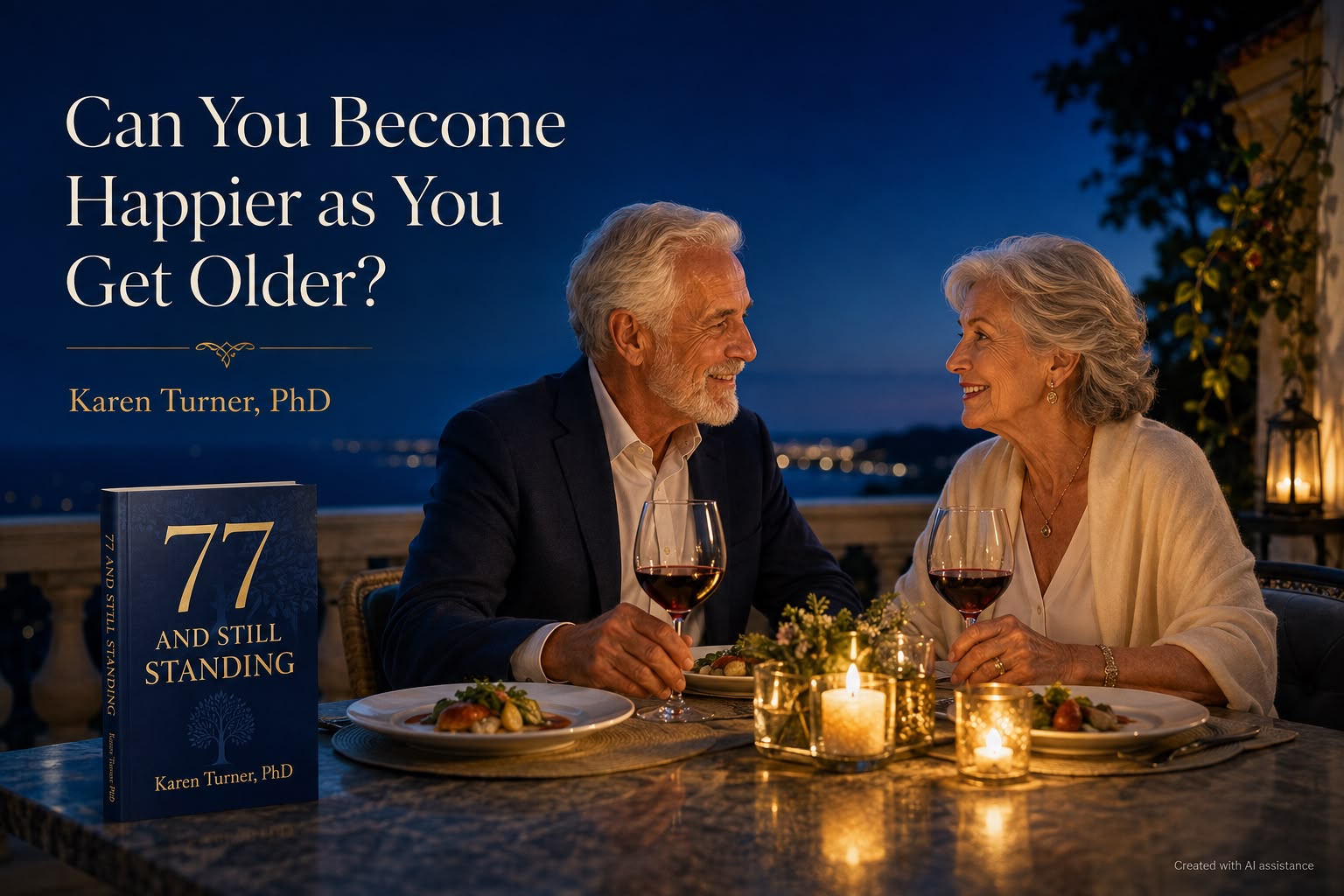
Yes, many people do become happier as they get older. Not because later life is free from loss, uncertainty, health concerns, or disappointment, but because age can bring a clearer understanding of what matters, greater emotional perspective, and far less willingness to spend precious time on people and expectations that diminish us.
Research on emotional aging has found that well-being can remain stable or even improve across adulthood. Older adults often become better at regulating their emotions, choosing meaningful relationships, and directing attention toward what actually gives life value.
But happiness in later life is not automatic. It depends on how you respond to change, where you place your energy, and whether you keep participating in the design of your own life.
Why Might People Become Happier With Age?
Happiness often deepens with age because our relationship to time changes. When we are younger, life can feel unlimited. We devote years to building careers, raising families, accumulating achievements, and meeting other people’s expectations, all on the assumption that there will be time for the rest later.
As we grow older, we begin to recognize that time is not an endless resource. That realization can be frightening, but it is also clarifying. We become more selective about our relationships. We stop trying to win every argument, please every person, or prove our worth through constant productivity.
The question gradually changes from “what am I supposed to do?” to “what genuinely matters to me now?” That shift creates a deeper and far more sustainable form of happiness than the achievement-driven version most of us chased at 40.
Does Happiness Mean Feeling Positive All the Time?
No. Genuine happiness does not require constant positivity, and insisting on it usually backfires.
Later life may include grief, loneliness, caregiving, retirement, physical changes, family conflict, or the loss of roles that once shaped your identity. Telling someone in the middle of that to “just be grateful” invalidates the real complexity of what they are living through.
Emotional health means being able to hold more than one truth at a time:
- You can miss someone and still enjoy your life.
- You can feel grateful and disappointed at once.
- You can be frightened by change and curious about what comes next.
- You can grieve who you were while appreciating who you have become.
Happiness is not the absence of difficult emotions. It is the ability to feel them without letting them become the entire story of your life.
Do Older Adults Become Better at Managing Emotions?
Many do. Experience teaches us that emotions change, crises pass, and not every upsetting moment deserves a permanent place in our minds.
With age, people become better at recognizing patterns. You learn which conflicts are worth addressing, which problems can genuinely be solved, and which situations simply require acceptance. You also tend to become less interested in emotional chaos for its own sake.
This does not mean older adults are never anxious, angry, or overwhelmed. It means they often have a broader vantage point from which to understand those feelings. They have survived difficult chapters before, and they know that a painful day is not necessarily a painful life.
Studies of emotional experience across adulthood have generally found that greater age is associated with more emotional stability and a more positive overall balance of emotions. This does not hold true for every individual, but it directly challenges the stereotype that aging leads inevitably to unhappiness. The same perspective underlies the science of hope in later life.
What Role Do Relationships Play in Later Life Happiness?
The quality of your relationships matters far more than the number of people in your life. As we grow older, most of us become more selective, wanting relationships that offer honesty, warmth, reciprocity, and emotional safety.
A crowded calendar cannot compensate for feeling unseen. One or two relationships in which you can be fully yourself will provide more emotional nourishment than dozens of superficial connections.
Relationships also affect happiness when they lack healthy boundaries. Continually tolerating disrespect, manipulation, or emotional depletion in the name of keeping the peace gradually erodes your well-being. Boundaries are not a rejection of love, they are a way of protecting the conditions in which healthy love can exist.
Sometimes becoming happier requires strengthening a relationship. Sometimes it requires one difficult conversation. And sometimes it requires accepting that not every relationship should continue in its present form.
Can You Be Happy After Retirement?
Yes, but retirement by itself does not guarantee happiness. Work provides more than income. It supplies structure, identity, social connection, recognition, and a reason to get up in the morning.
When a career ends, people often feel relieved and disoriented at the same time. The loss of a professional role leaves a psychological space that leisure alone rarely fills, because endless free time is not the same thing as meaningful time.
Happiness after retirement tends to grow when you develop new sources of purpose: mentoring, volunteering, learning, creating, writing, advocacy, caregiving, community involvement, or simply being genuinely present for the people you love. Purpose does not have to be grand, it has to be real. If you are still working out where yours went, it is worth reading more about how to find meaning after retirement.
What Gets in the Way of Happiness as We Age?
The single greatest obstacle is the belief that the most important parts of life are already behind you.
When people begin speaking about themselves only in the past tense, they gradually withdraw from possibility. They stop initiating. They stop imagining. They stop asking what they want. They shrink their lives before circumstances ever require it.
The second obstacle is comparison. Measuring your current body, energy, opportunities, or appearance against those of your younger self turns every ordinary change into evidence of loss. The goal is not to pretend nothing has changed, but to stop using youth as the only measure of a valuable life.
Can Gratitude Make You Happier?
Gratitude genuinely supports emotional well-being, but it should never be used to silence pain.
Healthy gratitude does not say “I have no right to be unhappy because others have it worse.” It says “even within a complicated life, I can notice what remains meaningful.”
You might find it in a conversation, a morning ritual, a grandchild’s laughter, a friend who still calls, work that continues to matter, or the quiet realization that you handled something far better than you would have twenty years ago. Gratitude is not denial. It is attention.
What Practical Changes Can Increase Happiness After 60?
Happiness is rarely created by one dramatic transformation. It is built through small, intentional choices, and the most useful place to begin is with honest questions.
- What consistently gives me energy?
- Which relationships allow me to be myself?
- Where am I saying yes when I want to say no?
- What have I postponed because I believe it is too late?
- What would make an ordinary week feel more meaningful?
- What am I still curious about?
Then choose one answer and act on it. Call the person. Register for the class. Set the boundary. Begin the project. Ask for support. Create something to look forward to. Happiness grows when you experience yourself as an active participant in your own life rather than a spectator to it.
Meaningful activity is not a small thing, either. The National Institute on Aging notes that participating in activities you find genuinely enjoyable is associated with better psychological and physical well-being as you age.
Is It Too Late to Become Happier?
No. You may not be able to change what has already happened, but you can absolutely reconsider what receives your attention now.
You can learn from the past without letting it define your future. You can release expectations that no longer fit. And you can seek professional support if anxiety, depression, grief, or loneliness has become overwhelming. Needing help is not evidence that you have failed at aging, it is evidence that you are taking your emotional life seriously.
You do not need to become an entirely different person. You may simply need to recalibrate.
Frequently Asked Questions
Are older people happier?
Often, yes. Research on emotional aging generally finds that emotional stability and the overall balance of positive to negative emotion improve or hold steady across adulthood. It is a tendency rather than a guarantee, and it depends heavily on health, relationships, and circumstances.
Can you be happy after retirement?
Yes, though retirement alone does not produce happiness. People who thrive usually replace what work provided, meaning structure, identity, connection, and purpose, rather than assuming free time will fill the gap on its own.
How can I find happiness after 60?
Start small and specific. Identify what gives you energy, which relationships let you be yourself, and what you have postponed because you assumed it was too late. Then act on one of those answers this week rather than waiting for a larger change.
What if I feel guilty for being unhappy at my age?
Guilt about unhappiness is common and rarely helpful. Difficult emotions in later life are usually responses to real losses and transitions, not personal failures. Gratitude and grief can coexist, and you are allowed to feel both.
When should I talk to a professional?
Consider speaking with a mental health professional if low mood, anxiety, hopelessness, or loneliness persists for weeks, interferes with daily life, or removes your interest in things you once enjoyed. Depression in later life is treatable and is not a normal part of aging.
Your Age Does Not Disqualify You From Happiness
Happiness in later life is not about pretending that aging is easy. It is about discovering that pleasure, connection, purpose, growth, and possibility still belong to you.
Your age does not disqualify you from happiness. It may finally clarify what happiness means.
Related Reading
- What Happy Retirees Do Differently
- The Science of Hope: Why Optimism Matters More Than Ever as We Age
- How to Find Meaning After Retirement
- The 7 Pillars of Aging Well
- Why Do Friendships Change After 60, and When Should You Let One Go?
- Why Do I Feel Less Important as I Get Older?
- What Does It Really Mean to Age Well?
- Why Does Time Seem to Move Faster as We Age, and Can We Slow It Down?
- 77 and Still Standing by Dr. Karen Turner