

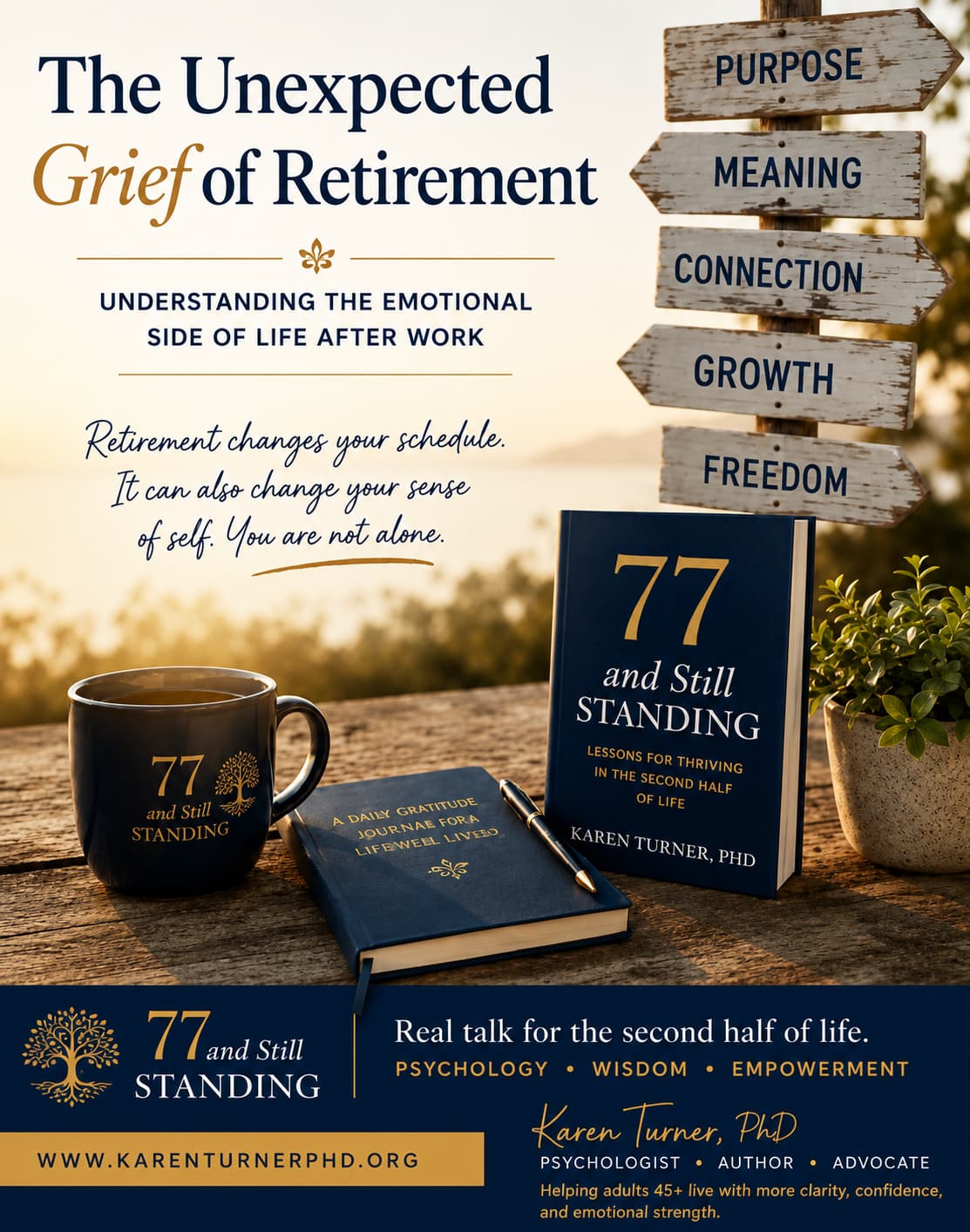
Most people imagine retirement will feel like freedom. Few expect it to feel like loss. Not catastrophic loss, but something subtler: a quiet disorientation, the strange emotional ache of no longer being woven into the daily rhythm of the world the way you once were.
Why Does Retirement Feel Like Grief Instead of Freedom?
For years, your life had structure. People depended on you. Your schedule mattered, your decisions mattered, your experience mattered. Then one day, often without much ceremony, that scaffolding begins to disappear: the alarm clock is no longer necessary, the emails slow down, the meetings stop, the urgency evaporates.
At first, this can feel deeply relieving. Many retirees are exhausted before they ever leave work, tired of deadlines, office politics, long commutes, and years of carrying responsibility. So retirement initially feels like exhaling. But after the first stretch of relief, another feeling often surfaces: now what? That question can become surprisingly emotional, because retirement is not simply the end of employment. It is the end of a role you inhabited for decades, and roles shape identity far more than most people realize.
What Did Work Actually Give You, Beyond a Paycheck?
For many baby boomers and older adults, work was never just about income. It was routine, competence, social interaction, purpose, momentum, recognition, and connection to the larger world. Even people who did not love their jobs often miss the feeling of participation, the sense that they were still needed somewhere. This is one of the hidden emotional realities of aging: we do not simply need rest, we need meaning, engagement, contribution, and connection to life outside ourselves.
When that structure suddenly disappears, many retirees experience an emotional vacuum no one prepared them for. Some feel restless, others feel anxious, others quietly depressed, and many simply feel untethered. Because retirement is culturally framed as something universally desirable, people often feel guilty admitting any sadness about it. After all, weren’t these supposed to be the golden years? But emotionally, unlimited freedom without direction can become surprisingly disorienting, especially for people whose identities were built around responsibility: the dependable one, the provider, the problem solver, the caretaker, the leader, the helper.
Is It Normal to Question Your Identity After Retiring?
Yes. When those roles diminish, people often begin questioning their value without realizing it. Who am I now? What gives my life shape now? What do my days mean now? These questions are not superficial. They are deeply psychological, and they often emerge more intensely during the first year of retirement.
In many ways, retirement resembles other major life transitions: children leaving home, divorce, relocation, loss. Even positive transitions can create grief, because grief is not only about losing people. It is about losing familiarity, rhythm, identity, and the version of yourself you once understood. Retirement can also expose emotional realities that work once distracted you from: loneliness becomes more noticeable, marital difficulties become harder to avoid, family estrangements feel louder, and health concerns become more emotionally present. Perhaps most powerfully, mortality becomes harder to ignore.
How Can Retirement Become Recalibration Instead of Just Loss?
Work often keeps people psychologically future-focused: goals, projects, deadlines, growth. Retirement shifts that landscape. Time begins feeling more immediate and more finite, which can either deepen anxiety or deepen clarity, sometimes both. Many older adults begin reevaluating everything after retirement: relationships, priorities, friendships, how they want to spend the years ahead. While that reevaluation can feel unsettling, it can also become profoundly liberating, because retirement is not only an ending. It can become a recalibration, not a reinvention: a movement toward greater honesty about what matters now.
Many people spent decades accommodating everyone else: meeting expectations, managing responsibilities, postponing themselves. Retirement sometimes creates the first real opening to ask what actually brings you alive, not what impresses others, not what once defined success, not what was expected. For some retirees, the answer becomes creativity: writing, painting, gardening, music. For others, it becomes relationships: grandchildren, friendships, community, volunteering, mentoring younger generations. Sometimes the goal is not productivity at all. Sometimes it is presence, learning how to inhabit life more fully instead of rushing through it.
What Does Healthy Emotional Retirement Planning Look Like?
We spend enormous time discussing financial retirement planning while almost completely ignoring emotional retirement planning. But emotional preparation matters just as much, because retirement is not merely logistical. It is existential. It asks difficult questions: who are you without your title, your productivity, external validation, or being urgently needed every day? Those questions can feel frightening at first, but they can also become clarifying. Healthy aging is not about remaining endlessly busy. It is about remaining:
- Emotionally engaged rather than simply occupied
- Still curious about what comes next
- Still connected to people and community
- Still participating in your own life
The Takeaway
Many older adults discover that beneath the loss is another possibility: relief from decades of proving, striving, and living entirely according to obligation. There is tremendous freedom in no longer needing to prove yourself endlessly. That shift does not happen automatically, but retirement can create the emotional space for it. The grief is real and should not be minimized. There are genuine losses in growing older. But there are also revelations: a deeper understanding of yourself, a clearer sense of what matters, and a quieter, more grounded relationship with life. Growing older is not simply about what disappears. Sometimes it is about finally seeing yourself clearly after decades of movement, noise, and obligation.
Related Reading
- Why So Many Successful People Feel Lost After Retirement
- What Happy Retirees Do Differently
- How to Find Meaning After Retirement
- Why Your Identity Doesn’t End When Your Career Does
- The Psychology of Regret: Why Your Best Years May Still Be Ahead
- Why Does Time Seem to Move Faster as We Age, and Can We Slow It Down?
- How to Let Go of Regret Later in Life, Without Pretending the Past Did Not Matter