

People-Pleasing, Boundaries, and the Freedom That Can Come With Age
For years, I apologized for things that were never mine to own.
I apologized when someone was disappointed. I apologized when I said no. I apologized when I could not solve someone else’s problem. Sometimes I apologized simply because another person was uncomfortable.
With age has come an important realization. Boundaries require far fewer apologies than people-pleasing ever did.
For many of us, growing older offers a chance to examine the emotional habits we have carried for decades and to ask a surprisingly powerful question: is this still mine to carry?
Why Do Some People Apologize So Much?
Chronic apologizing is often not about having done anything wrong. It is an emotional strategy.
People learn to apologize as a way of reducing conflict, protecting relationships, gaining acceptance, or reassuring themselves that someone is not angry with them. Over time, the words “I am sorry” become shorthand for something else entirely:
- Please do not be upset with me.
- Please do not reject me.
- Please still think I am a good person.
- Please let everything be all right.
The pattern can become so automatic that we barely notice we are doing it. That is precisely what makes it worth examining.
What Is the Connection Between People-Pleasing and Over-Apologizing?
People-pleasing usually grows out of a belief that maintaining another person’s happiness is partly our responsibility. Once that belief takes hold, a familiar set of behaviors tends to follow:
- Saying yes when we want to say no.
- Avoiding disagreement.
- Taking responsibility for other people’s feelings.
- Feeling guilty whenever we disappoint someone.
- Needing approval or reassurance.
- Overexplaining our decisions.
- Apologizing for having needs at all.
- Worrying excessively about what others think.
These behaviors may have served us well earlier in life. They smoothed relationships and kept the peace. But something that once protected us can eventually begin to restrict us.
Why Can Setting Boundaries Feel So Uncomfortable?
A boundary sounds simple enough: this is what I can do, and this is what I cannot do. Emotionally, it is far more complicated.
If you have spent decades being accommodating, saying no will feel selfish at first. If you have spent decades avoiding conflict, disagreement will feel dangerous. If you have learned to measure your worth by other people’s approval, disappointing someone will feel like failure.
But discomfort does not mean you have done something wrong. Sometimes discomfort simply means you are doing something differently.
Do Healthy Boundaries Require an Apology?
Usually not, and the distinction that matters here is between hurting someone and disappointing someone.
If we have genuinely behaved badly, an apology is an expression of responsibility and empathy. But another person’s disappointment does not mean we have harmed them.
You can say “I am not able to do that” rather than “I am so sorry, but I am not able to do that.” You can say “that does not work for me” without supplying a paragraph of justification. And you can disagree with someone while still caring deeply about them.
A boundary is not a punishment. It is information about where one person ends and another begins.
Why Might Boundaries Become More Important as We Grow Older?
One of the psychological gifts of later life is perspective.
By our sixties, seventies, eighties and beyond, most of us have spent decades filling roles. We have been spouses, parents, grandparents, professionals, caregivers, friends, problem-solvers and peacemakers. Some of those roles brought enormous meaning. They may also have taught us to place ourselves last as a matter of course.
Growing older gives us a chance to reconsider that arrangement. Not because other people suddenly matter less, but because we matter too, and it may have been a very long time since that was reflected in how we spend our days.
What Are We Finally Allowed to Put Down?
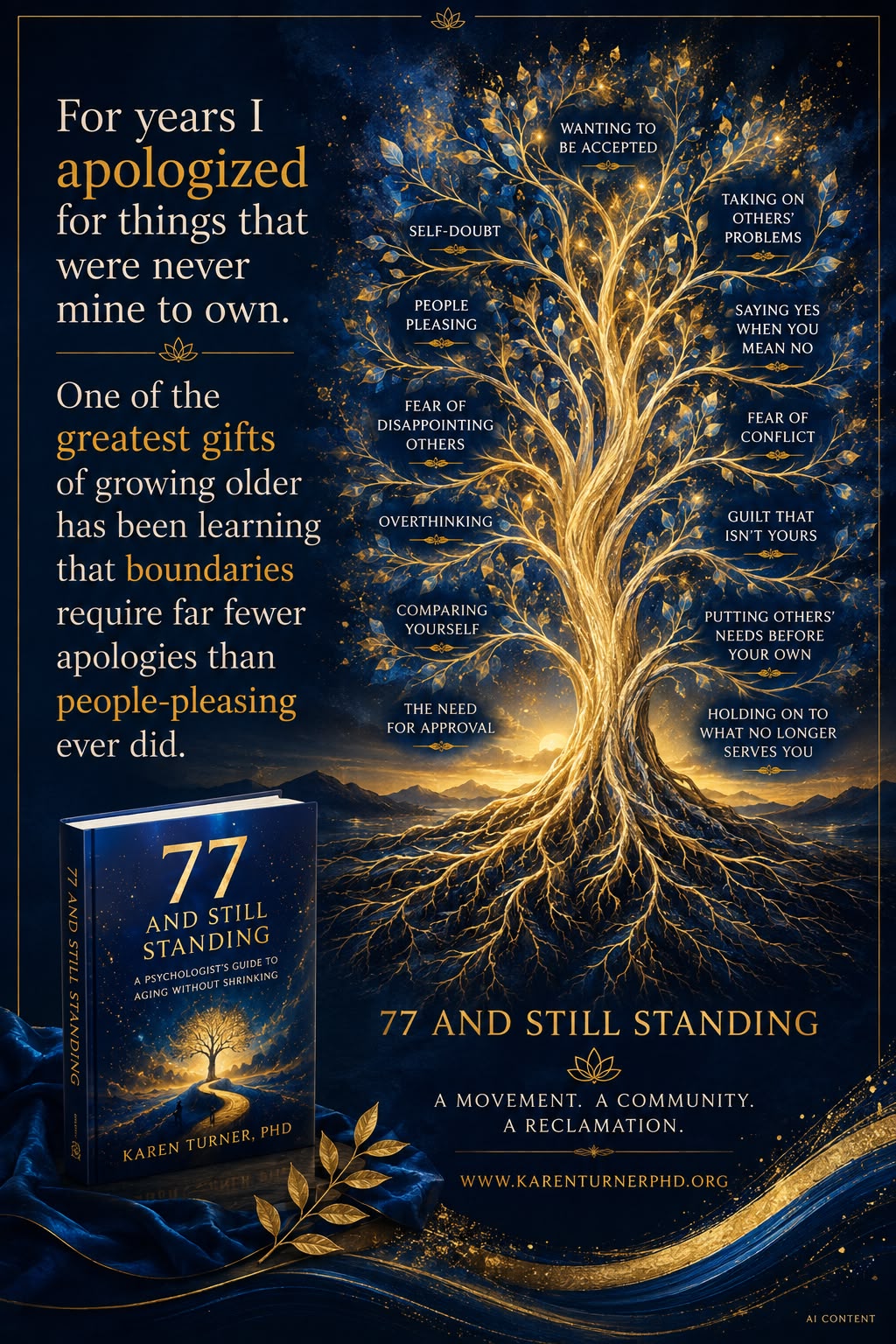
Imagine a tree that has been growing for decades. Its branches carry old messages: wanting to be accepted, self-doubt, people-pleasing, fear of disappointing others, fear of conflict, taking on other people’s problems, saying yes when you mean no, guilt that is not yours, the need for approval, and holding on to what no longer serves you.
Perhaps growing older is not about adding more and more branches. Perhaps some of our growth comes from deciding which ones no longer need to remain.
This is the quiet version of making yourself smaller without ever deciding to, only in reverse. Putting something down deliberately is not the same as disappearing.
How Do I Stop Apologizing for Things That Are Not My Fault?
Start by noticing the apology before trying to eliminate it. The next time you hear yourself say “I am sorry,” pause and ask what exactly you are apologizing for.
Did I hurt someone? Did I act against my own values? Did I make a mistake that deserves repair? Or am I apologizing because someone is disappointed, uncomfortable, or unhappy with a decision I am entitled to make? That distinction is the whole of it.
Then replace the unnecessary apologies with clearer language:
- Instead of “I am sorry I cannot come,” try “Thank you for thinking of me. I will not be able to come.”
- Instead of “I am sorry to bother you,” try “Do you have a moment?”
- Instead of “I am sorry, but I disagree,” try “I see this differently.”
These look like tiny changes. Psychologically, they are not. They move us from automatic self-blame toward intentional communication, and that shift tends to be felt by everyone in the conversation.
Is It Selfish to Set Boundaries With Adult Children, Family or Friends?
No. Healthy boundaries and loving relationships are not opposites. Boundaries usually make relationships more honest, not less warm.
You can love an adult child without solving every problem. You can care about a friend without always being available. You can support a family member without accepting behavior that hurts you. You can change your mind. You can protect your time. You can decide that something you tolerated at 50 is no longer acceptable at 70.
You can do all of that without becoming uncaring. The principle holds whether you are setting boundaries with grandchildren, reconsidering a friendship that has stopped being mutual, or holding your ground when adult children disapprove of a choice you have made.
What Does Aging Without Shrinking Mean?
To me, aging without shrinking means refusing to gradually disappear from your own life.
It means remaining curious. Having preferences. Expressing opinions. Continuing to learn. Setting boundaries. Choosing relationships thoughtfully. Creating meaning. And recognizing that growing older does not require becoming smaller so that everyone else stays comfortable.
This is not about becoming rigid or selfish. It is about becoming more intentional. That idea sits at the center of 77 and Still Standing: A Psychologist’s Guide to Aging Without Shrinking.
I do not believe later life has to be viewed primarily as decline. It can also be a period of design. We can decide what we want to keep. We can decide what we want to change. And perhaps most importantly, we can decide what we are finally ready to put down.
Frequently Asked Questions
Why do I apologize for everything?
Frequent apologizing is usually a learned strategy rather than a sign of genuine wrongdoing. It works to reduce conflict, secure acceptance, and confirm that no one is angry with you. Once the habit is established it runs automatically, which is why it often continues long after the circumstances that created it have gone.
Why do I feel guilty when I set boundaries?
Guilt in this situation is usually a sign of unfamiliarity rather than wrongdoing. If you have spent decades treating other people’s comfort as your responsibility, declining a request genuinely feels like a violation. The feeling tends to soften with repetition, particularly once you see that most relationships survive a boundary intact.
Do healthy boundaries require an apology?
Not usually. Apologize when you have actually hurt someone or acted against your own values. Disappointing someone is different from harming them, and a boundary stated plainly and kindly does not require an apology attached to it.
Is it selfish to set boundaries with family?
No. Boundaries define what you can offer sustainably, which usually makes you more available over the long term rather than less. Relationships that can only continue while you have no limits are not being protected by your silence, they are being propped up by it.
Do people become better at setting boundaries as they age?
Many do. Later life often brings a clearer sense of what matters, less patience for conflicts that lead nowhere, and a sharper awareness that time is finite. That combination makes it considerably easier to say no, though it rarely happens automatically. It generally takes deliberate practice.
A Question Worth Asking Yourself
The next time you find yourself apologizing automatically, stop for a moment and ask: is this actually mine to own?
If the answer is yes, take responsibility. If the answer is no, perhaps you do not need another apology. Perhaps you need a boundary.
At 77, this is one of the lessons I value most. For years I apologized for things that were never mine to own. One of the greatest gifts of growing older has been learning that boundaries require far fewer apologies than people-pleasing ever did.
Related Reading
- When Helping Your Adult Children Begins to Hurt You
- Aging Without Shrinking: How to Grow Older Without Losing Yourself
- How to Stay Emotionally Strong During Life’s Biggest Challenges
- Could You Be Becoming Smaller Without Even Realizing It?
- Why Do Friendships Change After 60, and When Should You Let One Go?
- When Your Adult Children Do Not Approve of Your New Relationship
- Why Do I Feel Less Important as I Get Older?
- How to Let Go of Regret Later in Life, Without Pretending the Past Did Not Matter
- 77 and Still Standing by Dr. Karen Turner