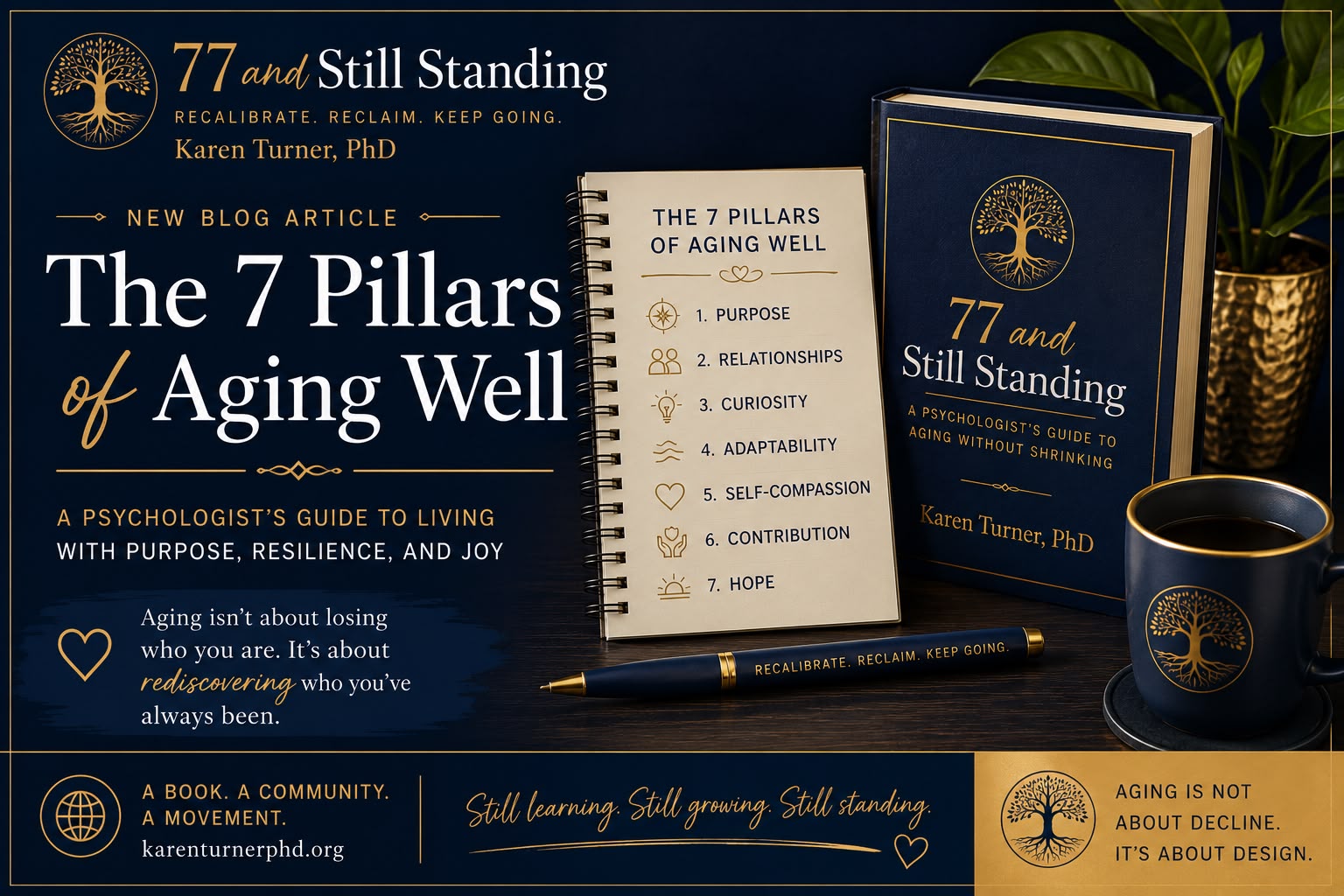
Aging well isn’t primarily about avoiding decline. It’s about building seven psychological pillars, purpose, relationships, curiosity, adaptability, self-compassion, contribution, and hope, strong enough that when one wobbles, the others hold you up.
Everyone wants to age well. But what does that actually mean? For many people, aging well is measured by what they don’t lose: health, memory, independence, or mobility. While those are certainly important, psychology teaches us something surprising: aging well is less about avoiding change and more about adapting to it.
The happiest older adults aren’t necessarily the healthiest or wealthiest. They’re often the ones who have built a strong psychological foundation, habits, attitudes, and relationships that support them through life’s inevitable transitions. Think of these as the seven pillars of aging well. When one pillar weakens, the others help hold you up.
Pillar 1: Purpose
Purpose gives each day direction, and it doesn’t have to be grand. You don’t need to start a nonprofit, write a bestselling book, or climb a mountain. Purpose might be reading to a grandchild, mentoring someone younger, volunteering, caring for a garden, learning a new skill, creating art, or helping a neighbor. Purpose answers one simple question: “Why am I getting up this morning?” People with purpose tend to experience greater resilience, better emotional health, and even improved physical well-being.
Pillar 2: Relationships
Loneliness isn’t simply being alone. It’s feeling disconnected. Strong relationships remain one of the greatest predictors of happiness throughout life, and quality matters far more than quantity. One trusted friend is more valuable than a hundred acquaintances. Healthy aging means investing in people who bring out your best, and just as importantly, letting go of relationships that consistently drain your peace.
Pillar 3: Curiosity
One of the greatest myths about aging is that learning belongs to the young. The opposite is true. Curiosity keeps your brain active, expands perspective, and reminds you that life is still unfolding. Take the class. Read the novel. Learn the technology. Visit the museum. Ask questions. The moment we stop being curious, we begin shrinking long before our bodies do.
Pillar 4: Adaptability
Life rarely unfolds according to plan. Health changes, families change, retirement changes us, loss changes us. The people who age well are not those who avoid change. They’re the ones who learn to adjust without losing themselves. Adaptability isn’t giving up. It’s learning new ways to move forward.
Pillar 5: Self-Compassion
Many older adults judge themselves harshly, criticizing their memory, appearance, energy, and changing abilities, yet they would never speak to a friend the way they speak to themselves. Self-compassion isn’t making excuses. It’s recognizing that growing older deserves kindness, not constant criticism. Treat yourself with the same understanding you freely give others.
Pillar 6: Contribution
We all need to feel useful. Retirement may end a career, but it doesn’t end your ability to make a difference. Contribution comes in many forms: listening, encouraging, teaching, volunteering, sharing wisdom, supporting family, and offering kindness. A meaningful life isn’t measured by how much you earn. It’s measured by how much of yourself you give.
Pillar 7: Hope
Hope isn’t wishful thinking. It’s the belief that tomorrow still holds possibility. Hope says, “I can still grow. I can still learn. I can still love. I can still matter.” Every new decade offers opportunities we couldn’t have imagined in the last one, and hope allows us to keep looking toward them. This pillar is so foundational that we’ve explored it on its own in The Science of Hope: Why Optimism Matters More Than Ever as We Age.
Why Do These Pillars Matter Together?
Think of these seven pillars like the legs of a sturdy table. Some days your health may wobble. Other days relationships become difficult. You may experience loss, disappointment, or uncertainty. When one pillar weakens, the others provide strength: purpose supports hope, relationships strengthen resilience, curiosity fuels adaptability, and contribution reinforces purpose. Together, they create a life that remains meaningful even as circumstances change.
If you’re looking for a shorter, more streamlined version of this framework, see our related piece, The Five Pillars of Aging, which covers the five most essential foundations.
Is Aging Well About Staying Young?
No. Our culture often treats aging as something to fight, but aging well isn’t about pretending you’re forty. It’s about embracing who you are today while remaining open to who you’re still becoming. Every stage of life offers something unique: wisdom, perspective, patience, freedom, and the confidence to care less about appearances and more about authenticity. Growing older doesn’t diminish your value. It often reveals it.
Final Thoughts
You don’t have to perfect all seven pillars. You simply have to keep strengthening them. Small choices made consistently create extraordinary lives: call the friend, take the walk, learn the skill, volunteer, forgive yourself, stay curious, keep hoping.
Aging well isn’t something that happens to you. It’s something you build, one day, one decision, and one meaningful connection at a time. And perhaps that’s the greatest lesson of all: aging isn’t about losing who you are. It’s about becoming the fullest expression of who you’ve always been.
The Seven Pillars at a Glance
- Purpose: Have a reason to get up each morning.
- Relationships: Invest in meaningful connections.
- Curiosity: Never stop learning.
- Adaptability: Bend without breaking.
- Self-Compassion: Treat yourself with kindness.
- Contribution: Continue making a difference.
- Hope: Believe your best days can still include growth, meaning, and joy.
Related Reading
- When Helping Your Adult Children Begins to Hurt You
- The Five Pillars of Aging
- The Science of Hope: Why Optimism Matters More Than Ever as We Age
- How to Stay Mentally Sharp as You Age: 12 Proven Habits
- The Psychology of Successful Aging
- Can You Become Happier as You Get Older?
- What Does It Really Mean to Age Well?
- 77 and Still Standing by Dr. Karen Turner