A Psychologist Explains Why Aging Well Is Not the Same as Staying Young
Aging well means continuing to live as a full participant in your own life, rather than managing a slow retreat from it. It is not measured by how young you look, how few medications you take, or how closely your seventies resemble your forties.
Most popular definitions of aging well are really definitions of aging slowly. They focus on preserving the appearance and capacity of youth, which quietly treats youth as the standard and every year past it as decline. That is a difficult standard to age into, because eventually everyone fails it.
A psychological definition is more useful, and considerably more achievable. Aging well has less to do with what your body can still do and much more to do with whether you are still choosing, still connected, still curious, and still willing to take up space in your own life.
What Does Aging Well Actually Mean?
Aging well means adapting to real change without surrendering the things that make your life yours. It involves several capacities working together rather than any single achievement.
- Purpose, meaning you still have reasons to get up that belong to you rather than to your former roles.
- Adaptability, meaning you can adjust how you live without concluding that your life is over.
- Relationships in which you are genuinely known, not merely useful.
- Boundaries that protect your energy, your time, and your dignity.
- Resilience, meaning you can absorb loss without letting it become your entire identity.
- Recalibration, meaning you keep revising what matters instead of defending a version of yourself that no longer fits.
Notice what is absent from that list. Nothing about appearance. Nothing about productivity. Nothing that requires perfect health. These are capacities available to someone using a walker, someone managing a chronic illness, and someone who has recently lost a spouse.
If you want the practical version of how these translate into daily habits, that is covered in the seven pillars of aging well and in the five pillars of healthy aging after 50. This article is about the question underneath them: what are those habits actually in service of?
Why Health and Appearance Are Not the Same as Aging Well
Health matters enormously, and none of what follows is an argument against taking care of your body. But health alone is a poor definition of aging well, for two reasons.
The first is that health is only partly within your control. Genetics, access to care, injury, and simple chance all play a role. If aging well requires excellent health, then a diagnosis becomes a personal failure, which is both untrue and cruel.
The second is that plenty of people are physically healthy and quietly miserable. They have outlived their sense of purpose. They are isolated, or trapped in relationships that require them to stay small. Being well is not the same as being alive and uninjured.
Appearance is an even weaker measure. The pressure to look young is largely a cultural product, and the World Health Organization notes that when people absorb negative stereotypes about age and turn them inward, it affects their behavior and their sense of self-worth. Chasing a younger appearance often means accepting the premise that older is worse, which is the belief doing the real damage.
This is why some people simply seem more alive than their age would predict, a pattern worth understanding on its own terms in the psychology behind why some people seem younger than their age.
Does Aging Well Mean Staying the Same?
No, and this is where many people become stuck. If aging well means remaining the person you were at 50, then every change reads as loss and every adjustment feels like a defeat.
Adaptability works differently. It asks what you actually want from an activity, then finds another route to it. The person who loved long hikes and now walks a shorter loop with a friend has not given up hiking, they have kept what the hiking was for: movement, air, company, the feeling of having gone somewhere.
The people who struggle most are usually not those who lost the most. They are the ones who decided that a particular version of their life was the only acceptable one. Adaptability is not lowering your standards, it is refusing to let one closed door define the size of the room.
This is the difference between recalibration and reinvention. You are not required to become someone new. You are asked to keep updating what matters, which is why recalibration is usually the more honest goal after 60.
What Role Does Purpose Play in Aging Well?
Purpose is what makes the day worth structuring. Without it, free time becomes empty time, and people describe feeling adrift even when nothing is obviously wrong.
The difficulty is that many people spent decades borrowing purpose from their roles. Work supplied it. Raising children supplied it. When those roles end, the purpose leaves with them, and it can be genuinely disorienting to discover you never developed one that was purely your own.
Purpose in later life rarely arrives as a grand calling. It usually looks like mentoring someone, learning something demanding, making things, advocating for a cause, tending a garden or a friendship, or being reliably present for people who need you. The National Institute on Aging notes that taking part in activities you find meaningful is associated with better psychological and physical well-being as you age.
The test of a purpose is not whether it impresses anyone, but whether it gets you out of bed on a day when nothing is required of you.
Why Do Relationships Matter So Much?
Relationships are the strongest single predictor of whether later life feels rich or hollow, and the quality of them matters far more than the number.
Social connection protects both mental and physical health, and the National Institute on Aging treats isolation as a genuine health risk rather than merely an unpleasant feeling. But the useful question is not how many people are in your life. It is whether any of them know you.
There is a particular loneliness that comes from being surrounded by people who value what you provide rather than who you are. It is common among those who spent a lifetime as the capable one, the organizer, the person everyone calls. Relationships built entirely on your usefulness tend to thin out precisely when you most need them, which is one reason feeling less important with age is so often about changed roles rather than lost value.
Can You Age Well Without Boundaries?
Not for long. Boundaries are what make the other elements of aging well sustainable, because time and energy in later life are finite in a way that is harder to ignore than it once was.
Without them, purpose gets crowded out by obligation. Relationships that deplete you consume the hours that might have gone to relationships that sustain you. You end up spending a scarce resource on things you would not choose if you were choosing deliberately.
Many people find boundaries hardest exactly when they matter most, because a lifetime of being agreeable makes refusal feel like a character flaw. It is not. A boundary is not a rejection of the people you love, it is a decision about where your remaining time goes. That decision sometimes means acknowledging that a friendship needs a new shape, or needs to end.
What Does Resilience Look Like in Later Life?
Resilience is frequently misdescribed as toughness, as though aging well means being undisturbed by loss. That version is not resilience, it is suppression, and it tends to collapse eventually.
Real resilience means feeling the full weight of something and still, over time, finding your way back to a life that has room in it. Later life brings genuine losses: people, capacities, roles, sometimes independence. Grief is the appropriate response, not a malfunction.
What distinguishes people who come through these losses is not that they hurt less. It is that they do not conclude the story is finished. They stay in contact with other people while grieving. They let themselves be helped. They allow the possibility that something good might still happen, which is a genuinely difficult act of faith after a hard year.
Resilience is the refusal to let the worst thing that happened to you become the last thing that defines you. It is also closely tied to whether happiness can still grow as you get older, which for most people it can.
How Do You Know If You Are Aging Well?
Rather than measuring yourself against your younger self, these questions tend to be more revealing:
- Do I have something I look forward to this week?
- Is there anyone who knows what is actually going on in my life?
- When did I last change my mind about something important?
- Am I saying yes to things out of genuine desire or out of habit and guilt?
- Have I tried anything for the first time in the past year?
- Do I talk about my life mostly in the past tense?
- Is there something I have stopped doing that I could still do in a modified form?
Uncomfortable answers are not a verdict. They are information about where to put your attention next. Aging well is not a state you arrive at and maintain, it is a series of small course corrections made repeatedly over years.
Frequently Asked Questions
What does it mean to age well?
Aging well means staying an active participant in your own life: keeping a sense of purpose, adapting to change without withdrawing, maintaining relationships in which you are genuinely known, protecting your energy with boundaries, and continuing to revise what matters as circumstances change. It is a psychological and relational description far more than a physical one.
Is aging well the same as healthy aging?
They overlap but are not identical. Healthy aging usually refers to physical function and disease prevention. Aging well includes health but also covers meaning, connection, autonomy, and emotional life. Someone can be physically healthy and aging poorly, and someone with significant health problems can be aging remarkably well.
Can you age well with a chronic illness or disability?
Yes. Purpose, connection, adaptability, and dignity do not require an undamaged body. Any definition of aging well that excludes people managing illness or disability is describing luck rather than character.
What is the biggest obstacle to aging well?
Usually the belief that the most meaningful part of life has already happened. That belief tends to produce withdrawal, and the withdrawal then confirms the belief. Aging well depends heavily on staying open to the idea that something worthwhile may still be ahead of you.
Is it too late to start aging well?
No. Because aging well is about participation rather than preservation, it can begin at any point. Reaching out to one person, resuming one abandoned interest, or setting one overdue boundary changes the trajectory more than most people expect.
Aging Well Is Not About Staying Young
The version of aging well that is sold to us is mostly about postponement: delaying decline, preserving what we had, holding a line against time. It is exhausting because it cannot ultimately be won.
The version worth pursuing is about participation. It asks whether you are still making real choices, still in contact with people who know you, still curious about something, still willing to occupy your own life rather than apologize for it.
Aging well is not about how much of your youth you manage to keep. It is about how much of yourself you are willing to keep bringing forward.
Related Reading
- The 7 Pillars of Aging Well
- The Five Pillars of Healthy Aging After 50
- Why Do Some People Seem Younger Than Their Age?
- Can You Become Happier as You Get Older?
- Why Do I Feel Less Important as I Get Older?
- Aging Without Shrinking: How to Grow Older Without Losing Yourself
- Why Does Time Seem to Move Faster as We Age, and Can We Slow It Down?
- Staying Single or Finding Love Again After 60
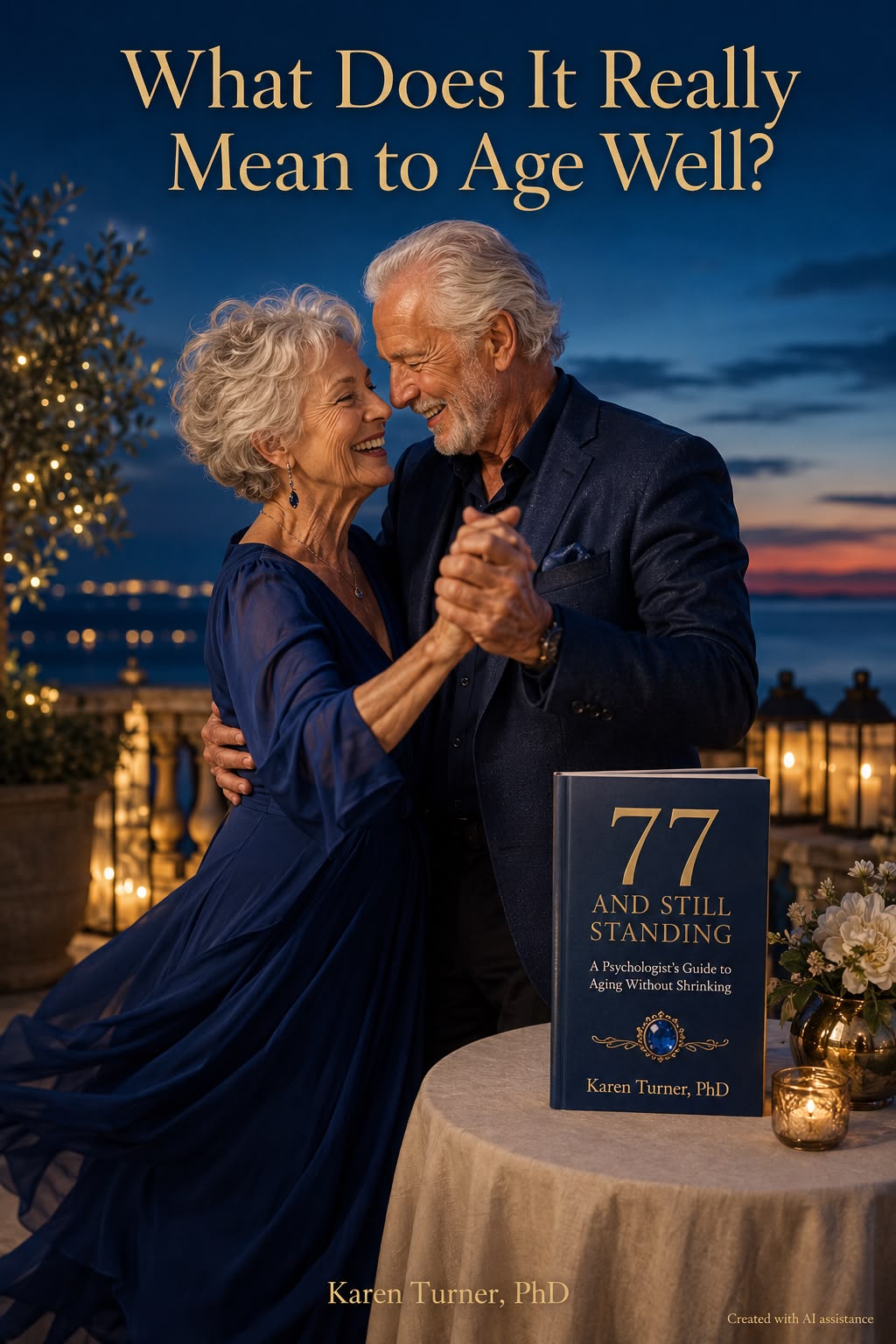
- 77 and Still Standing by Dr. Karen Turner