

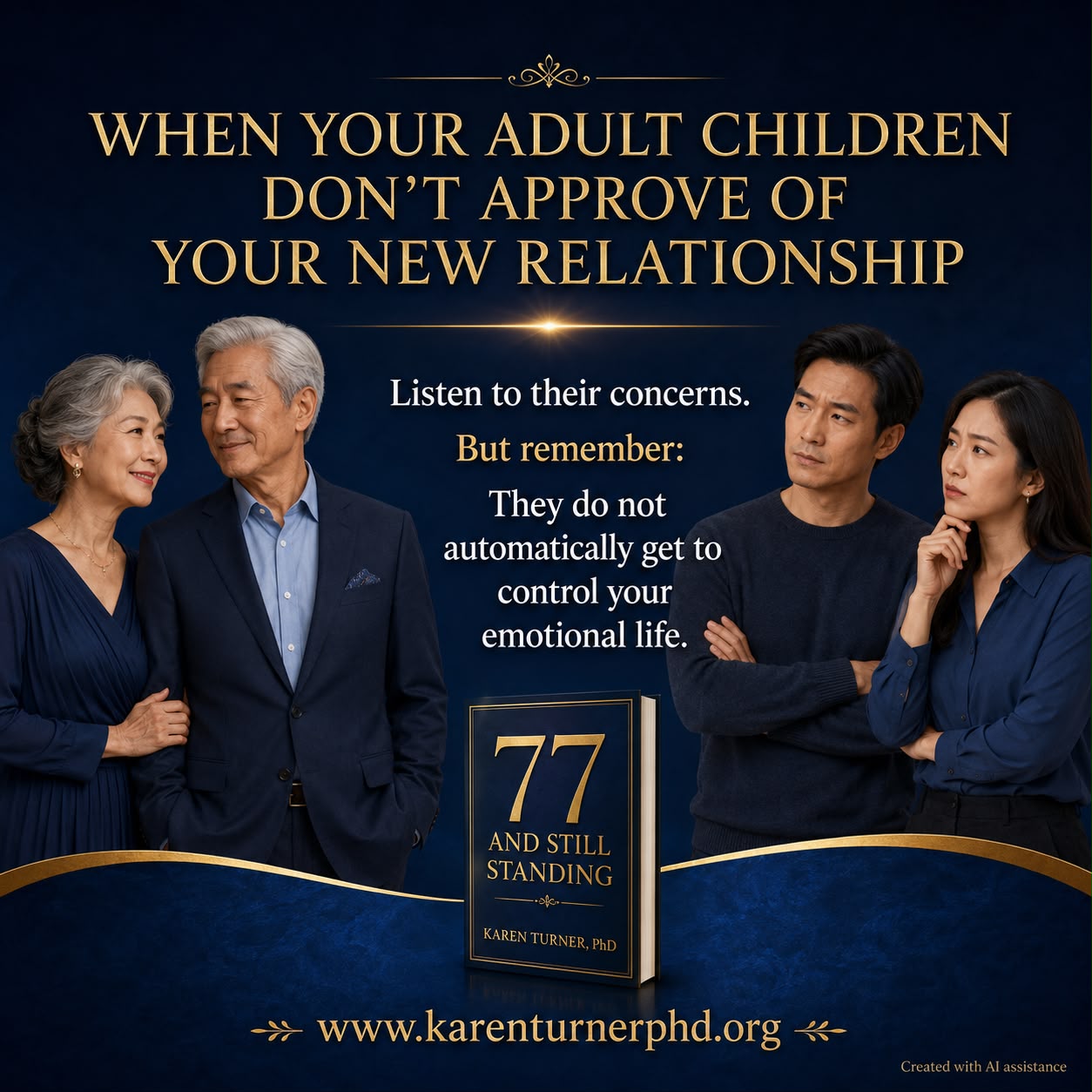
A Psychologist Explains How to Weigh Their Concerns Without Surrendering Your Autonomy
Finding love in the second half of life can feel hopeful, surprising, and deeply meaningful. But when your adult children disapprove, that happiness quickly becomes complicated by tension, guilt, defensiveness, and divided loyalties.
They may question your partner’s character, motives, finances, or influence. They may think you are moving too quickly. They may fear the relationship will change the family, affect an inheritance, or diminish the memory of a parent who died.
Sometimes their concerns identify something real that you have not let yourself see. Sometimes their reaction is mostly about their own fear, grief, or difficulty accepting that your emotional life still belongs to you.
The task is to listen without surrendering your autonomy. Your children’s concerns may deserve serious attention. Their discomfort does not automatically give them authority over your choices.
Why Do Adult Children Sometimes Object?
Adult children react strongly to a parent’s new relationship for a range of reasons, and it helps to know which one you are actually dealing with.
Some are genuinely protective. They understand that romance makes anyone vulnerable, particularly when a new partner applies pressure around money, marriage, property, caregiving, or estate plans.
Others are reacting to speed. What feels natural and exciting to you can look sudden to children still adjusting to the idea that you are dating at all.
Often the objection is tangled up with grief. After the death of a parent, a new partner can feel like an intrusion into a family story the children believed was permanent, and they may fear their late parent is being quietly replaced. Even after a divorce, adult children may hold an idealized picture of the original family, and your new relationship forces them to accept that the old structure is not coming back.
Some resistance is practical: worry about inheritance, property, future caregiving, or a stranger gaining influence over important decisions. And sometimes the explanation is simpler still. Your children may just not like the person you have chosen. That does not automatically make them right, but it does not automatically make them wrong either.
How Do You Tell a Real Warning From Simple Disapproval?
Listen for specifics. There is a significant difference between a child saying “I do not like this” and one saying “I have noticed that this person repeatedly asks you for money.”
General disapproval tells you how your child feels. Specific observations give you something you can actually evaluate. Ask them directly:
- What exactly concerns you?
- What have you observed?
- Is this based on something my partner has said or done?
- Are you worried about my emotional well-being, my finances, or changes in the family?
- What would help you feel more comfortable?
You do not have to agree with the answers. But asking for examples moves the conversation from accusation toward evidence, and it usually reveals whether you are hearing a genuine warning sign or a difficulty with change.
Should You Worry If Several People See the Same Thing?
Yes, this is worth pausing for. One person’s reaction may be colored by personality, jealousy, old family conflict, or plain discomfort with your choices. But when several trusted people independently raise similar concerns, look more closely.
This is not letting others vote on your relationship. It is acknowledging that people outside a romantic bond sometimes see patterns more clearly than the people inside it.
Ask yourself whether you have become more isolated, anxious, secretive, financially exposed, or diminished since the relationship began. Notice whether you keep defending behavior that would once have troubled you. Love deserves openness, but it should never require you to suspend your judgment.
Could Your Children Be Responding to Grief?
When a parent has died, adult children often experience a surviving parent’s new relationship as a threat to the bond they still feel with the person they lost. Underneath the objection are questions they may never say out loud: Did the marriage mean as much as I believed? Will this person replace my mother or father? Will our traditions disappear? Does loving someone new mean the parent I lost mattered less?
These fears are not always logical, but they are powerful. You can reassure your children that love is not erased when another relationship begins, and that a new partner does not have to replace anyone. The heart can hold one important relationship while making room for another.
At the same time, children may need time to adjust, and you can respect their grief without putting your own life permanently on hold. Grief deserves patience, not a veto.
Are They Concerned About Your Finances?
Financial concerns should never be dismissed simply because a relationship feels loving. By the second half of life, most people have homes, retirement accounts, investments, businesses, insurance policies, inheritances, and estate plans that took decades to build. A new partner may bring their own obligations, debts, adult children, and expectations about how resources ought to be shared.
Before changing property ownership, combining accounts, lending substantial money, altering beneficiaries, cosigning a loan, or revising an estate plan, get independent legal and financial advice. Independent means the professional represents your interests, not your partner’s and not your children’s.
This protects everyone, and it often reassures adult children that your decisions are being made carefully rather than impulsively. Responsible planning is not an insult to love. A trustworthy partner will respect your wish to protect your own security.
What Warning Signs Genuinely Deserve Attention?
Your children may have legitimate grounds for concern if your partner does any of the following:
- Pressures you toward rapid commitments.
- Asks for money or financial help early in the relationship.
- Encourages you to change your will, beneficiaries, or property ownership.
- Discourages you from speaking with your attorney, accountant, or financial advisor.
- Becomes jealous of your family, friendships, or independence.
- Tries to isolate you from anyone who questions the relationship.
- Dismisses your boundaries.
- Regularly leaves you feeling guilty, confused, frightened, or responsible for their emotions.
- Alternates between intense affection and sudden withdrawal.
- Avoids reasonable questions about finances, past relationships, or personal history.
- Responds with anger or punishment when you say no.
Several of these are also hallmarks of romance fraud, which targets older adults specifically, and the Federal Trade Commission publishes clear guidance on recognizing it.
One uncomfortable incident does not define a person. Patterns do. Pay particular attention to how your partner responds when you set a boundary, because respect for the word no reveals more about character than any romantic promise.
What If Your Children Simply Do Not Want You Dating?
Sometimes the objection has little to do with the particular partner. Your adult children may be uncomfortable seeing you as a person with romantic, emotional, or sexual needs at all, preferring to think of you only as their parent or grandparent.
Many are comfortable with a parent dating as an abstract idea, and find their feelings shift once the relationship becomes serious and starts affecting holidays, schedules, travel, and family traditions.
Their discomfort is understandable and worth acknowledging. But discomfort is not authority. You remain entitled to companionship, affection, privacy, pleasure, and love. Parenthood does not require you to surrender your emotional life indefinitely, and your value was never confined to your usefulness to your family.
How Do You Avoid Turning the Relationship Into a Loyalty Test?
Family conflict escalates fastest when everyone starts demanding proof of loyalty. Adult children may insist that if you really loved them, you would end the relationship. A partner may insist that if you really loved them, you would stop listening to your children.
Both demands should worry you. You should not have to reject your family to prove your commitment to a partner, and you should not have to abandon a healthy relationship to prove your devotion to your children.
A loving partner understands that your children remain important. Loving adult children recognize that you remain entitled to make your own choices. Healthy relationships make room for more than one meaningful bond.
What Boundaries Should You Set, and With Whom?
Boundaries are usually needed in both directions, which surprises people who assume the problem sits only on one side.
With your children, it might sound like: “I want to understand your concerns, especially if they are based on something specific. I will listen carefully. But the final decision about this relationship is mine.”
With your partner, it might sound like: “My children matter to me. You do not have to agree with them, but I will not accept any attempt to separate me from my family.”
Boundaries will not make everyone comfortable. What they do is clarify what behavior you will and will not accept. Your children are allowed to have feelings about the relationship. They are not entitled to interrogate you constantly, insult your partner, monitor your private life, or threaten to withdraw their love unless you obey. Equally, your partner is allowed to feel hurt by their disapproval, but that never licenses them to demand distance from your family.
Should You Rush to Integrate a New Partner Into the Family?
No. A new partner does not need to attend every family gathering immediately, and adult children generally respond better when a relationship is introduced gradually and they are given room to adjust.
Let the relationships develop without forcing an artificial closeness. Your children may never feel the warmth toward your partner that you are hoping for, and respectful behavior is a more realistic first goal than affection.
The same patience applies in reverse. Your partner should not be expected to step into a parental or grandparent role before trust has actually formed. A relationship can matter enormously without being immediately woven into every part of family life.
What If Your Children Refuse to Accept the Relationship?
You cannot force acceptance. What you can do is invite conversation, offer reassurance, take specific concerns seriously, protect yourself financially, and hold clear boundaries. After that, how your adult children respond is their decision to make.
At some point you may need to say plainly: “I understand that you do not approve. I hope you will stay part of my life, and I will keep taking your concerns seriously. But I cannot let your disapproval decide whether I am allowed to have this relationship.”
That is not rejection, it is differentiation. You are recognizing that you and your adult children can love each other without agreeing about every personal decision. The same principle applies when family expectations quietly become obligations.
Questions to Ask Yourself Honestly
Before concluding that your children are merely being controlling, sit with these:
- Am I moving faster than I normally would?
- Have I overlooked behavior that once would have concerned me?
- Has my partner encouraged distance between me and people I trust?
- Do I feel more like myself in this relationship, or less?
- Can I disagree without fearing anger, punishment, or withdrawal?
- Are my financial and legal interests genuinely protected?
- Would I make these same financial decisions if romance were not involved?
- Are my children describing specific behavior, or expressing discomfort?
- Have I given them reasonable time to adjust?
- Am I defending this relationship because it is healthy, or because I am afraid of being alone?
- Does this relationship expand my life, or require me to shrink?
Honest reflection is not a betrayal of your partner. It is protection of yourself.
Frequently Asked Questions
Should adult children have a say in a parent’s relationship?
They are entitled to voice concerns, particularly specific ones about behavior, safety, or finances, and those deserve genuine consideration. They are not entitled to make the decision. Input and authority are different things, and a competent adult retains the right to choose their own partner.
What if my children dislike my new partner?
Ask what exactly they have observed. If they describe specific behavior, take it seriously and look honestly at whether you have been explaining it away. If they only express discomfort with change, give them time, introduce the relationship gradually, and aim for civility rather than affection at first.
How can I date after widowhood without upsetting my children?
You may not be able to avoid upsetting them entirely, and that is not a reason to stop. Tell them directly that a new relationship does not erase or diminish their other parent. Move at a measured pace, keep family traditions and photographs where they matter, and let them adjust without treating their grief as a veto.
Should I change my will or finances for a new partner?
Not without independent legal and financial advice from a professional representing your interests alone. Be especially wary of any pressure to act quickly on property, beneficiaries, or estate documents. Reluctance from a partner about you consulting your own advisors is itself significant information.
What if the conflict is damaging my relationship with my children?
Keep the door open even when they will not walk through it. Continue to invite contact, avoid making them choose sides, and do not let a partner escalate the estrangement. If the rift persists, family therapy can help, and it is often easier to accept when framed as protecting the relationship rather than settling the argument.
You Are Entitled to Both Love and Discernment
Finding love later in life does not make you foolish, desperate, or incapable of judgment. Nor does it commit you to merging finances, sharing a home, marrying, or rearranging your entire life. A relationship can be designed around the people you are now.
You can move slowly. You can keep separate homes. You can protect your finances, preserve your friendships and family relationships, and take legal advice. You can stay open to love without surrendering your independence.
Your adult children may be seeing something you genuinely need to examine. They may also be struggling to accept that you still have needs, choices, and possibilities beyond your role as their parent. Listen carefully. Look honestly. Protect your boundaries and your financial security.
But growing older does not transfer ownership of your emotional life to your children. You are still entitled to make thoughtful choices, to have companionship, and to find love in the second half of life.
Related Reading
- Staying Single or Finding Love Again After 60
- What Aging Parents Wish Their Adult Children Knew
- When Expectations Hurt: Letting Go of the Family Story You Thought Would Happen
- When Adult Children Pull Away: Understanding Emotional Distance
- When Adult Children Become Caregivers
- Why Do I Feel Less Important as I Get Older?
- Why Do I Apologize for Everything? People-Pleasing, Boundaries, and the Freedom That Can Come With Age
- Estranged From Your Adult Children After Divorce? How to Cope and Rebuild
- 77 and Still Standing by Dr. Karen Turner