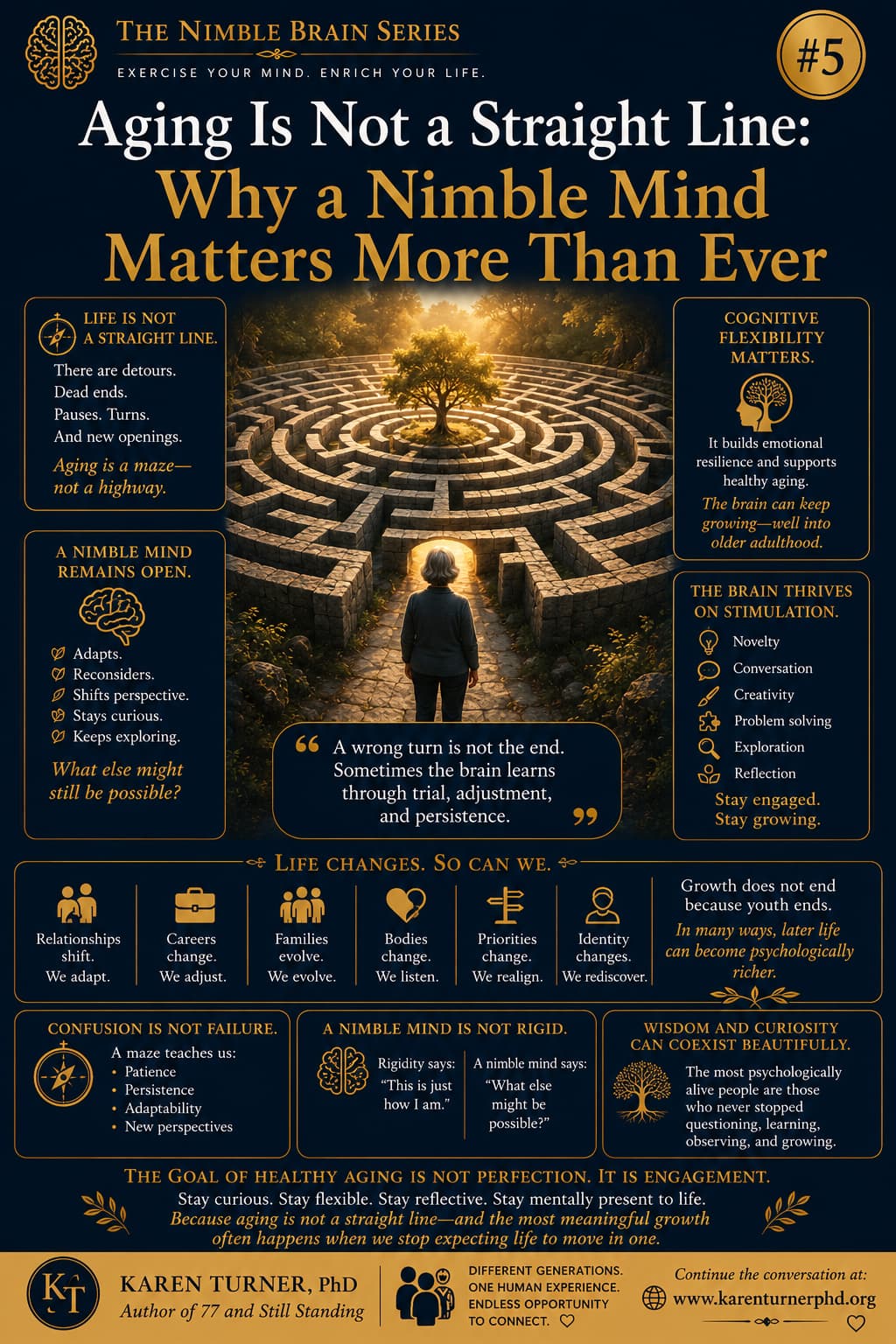
Most of us grow up believing life moves in a straight line: from goal to goal, one steady climb. Then life happens, and we discover something else entirely. Aging is less like a highway and more like a maze: full of detours, dead ends, and unexpected openings, and the healthiest minds are the ones willing to keep searching for another path.
This article opens our Nimble Mind Series, three pieces exploring how curiosity, cognitive flexibility, and a willingness to keep exploring shape healthy aging.
Why Doesn’t Life Move in a Straight Line?
Because growth was never meant to be linear. There were detours, delays, unexpected losses, relationships that changed shape, and versions of ourselves we never anticipated becoming. At some point, most adults realize life is far more like a maze than a highway: you move forward, hit a dead end, double back, pause, regroup, and discover another opening. That is especially true in the second half of life, and it is why the image of a maze feels strangely symbolic, not simply as a brain challenge, but as a reflection of life itself.
What Is Cognitive Flexibility, and Why Does It Matter After 50?
Cognitive flexibility is the brain’s ability to adapt, reconsider, shift perspective, and remain open to new possibilities. It is one of the most important components of emotional resilience and healthy aging. A nimble mind does not become rigid, does not assume there is only one way forward, and stays curious enough to keep exploring. Contrary to cultural stereotypes, this kind of flexibility can keep developing throughout life. The human brain retains remarkable adaptability well into older adulthood, and neuroscience increasingly supports the idea that it remains capable of forming new neural connections through continued engagement and stimulation.
That matters enormously, because many people unconsciously begin shrinking psychologically as they age, not because they are incapable, but because they quietly stop challenging themselves. Life becomes repetitive, predictable, emotionally narrow. The brain thrives on novelty, conversation, creativity, problem solving, exploration, and reflection.
Even something as deceptively simple as a maze activates multiple cognitive functions at once:
- Attention
- Planning
- Visual scanning
- Problem solving
- Persistence
- Adaptability
And perhaps most importantly: patience, because not every path immediately works. That lesson extends far beyond puzzles.
Does Later Life Get Psychologically Harder, or Richer?
Many adults spend years believing they must have life completely figured out by a certain age. Real life rarely operates that way. Relationships shift, careers change, families evolve, bodies change, priorities change, identity changes, and sometimes the very things that once defined us no longer fit. That can feel disorienting. Yet there is also freedom in recognizing that growth does not end simply because youth ends. In many ways, later life can become psychologically richer. People often become:
- Less performative
- Less concerned with external approval
- More emotionally honest
- More reflective
- More aware of what truly matters
The challenge is remaining mentally engaged enough to continue evolving, because the opposite of a nimble mind is not aging. It is rigidity. Rigidity says, “This is just how I am.” A nimble mind asks, “What else might still be possible?”
What Can a Maze Teach Us About Emotional Resilience?
There is something quietly comforting about mazes: they remind us that confusion is not failure, and a wrong turn is not the end. Sometimes the brain learns through trial and error, through adjustment, through persistence, and that is true emotionally too. Many people arrive in the second half of life carrying years of accumulated emotional habits, including:
- Over-caretaking
- People pleasing
- Chronic self-neglect
- Avoidance
- Fear of disappointing others
Eventually they realize those old pathways no longer lead where they want to go, so they begin searching for another route: a healthier one, a calmer one, a more authentic one. That process can feel uncomfortable at first, but growth often does. The brain develops through challenge, not stagnation.
Can Wisdom and Curiosity Coexist?
Yes, and one of the most hopeful truths about aging is that they coexist beautifully. People sometimes assume curiosity belongs only to the young, but some of the most emotionally intelligent, insightful, and psychologically alive individuals are older adults who never stopped questioning, learning, observing, and growing. A nimble brain is not necessarily the fastest brain. It is the brain willing to remain open: open to change, open to discovery, open to revising old assumptions, open to seeing life differently. That openness matters deeply in a world that constantly changes around us, and it is part of why simple challenges like the optical illusions in this series resonate so strongly. They gently remind us that the mind still wants to explore, still wants to solve, still wants to find a way through.
What Does Healthy Aging Actually Look Like?
The goal of healthy aging is not perfection. It is engagement: not becoming smaller emotionally or intellectually, not disappearing quietly into routine and predictability, but remaining mentally present to life. Curious. Flexible. Reflective. Alive. Aging is not a straight line, and sometimes the most meaningful growth happens after we stop expecting life to move in one.
Related Reading: The Nimble Mind Series
- What Do You See First? The Aging Brain Still Loves Surprise
- Can You Find the Hidden Face in Under 10 Seconds?
- What Do You See First? The Psychology Behind Optical Illusions and a Nimble Mind
- How to Stay Mentally Sharp as You Age: 12 Proven Habits
- Why Does Time Seem to Move Faster as We Age, and Can We Slow It Down?
- 77 and Still Standing by Dr. Karen Turner